
Auditing your influencer program
Problem: Your ads have already found most of the people they can, so more spend mostly shows the same people your ads again (with diminishing returns).
Founder · September 16, 2026 · 12 min read
This is written for those who:
- Are already running a influencer program a their company and want a diagnostic on what is working and what is not.
Metrics
Check your own numbers against the 493 D2C product brands in our records
| Check | Weak (worst quarter) | Typical | Strong (best quarter) |
|---|---|---|---|
| Creators booked twice or more on YouTube | under 36% | 55% | 69% or more |
| Creators booked again more than 60 days later | under 25% | 38% | 55% or more |
| Sponsored videos per creator | under 2.3 | 3.7 | 7.5 or more |
| Days between a creator's sponsored videos | over 36 | 27 | 15 or fewer |
| Brand percentage compared to other sponsors on the channel | over 30% | 16% | 9% or less |
| Creators kept from one year to the next | under 19% | 36% | 53% or more |
| Creators still posting in the last 180 days | under 19% | 33% | 50% or more |
- Commission rates are all over the place and nobody set them on purpose
If you have this problem, use this type of campaign
| If you have this problem | Use this type of campaign |
|---|---|
| A new product has no buyers yet, and word of mouth is slow to start. | Product launches |
| Once a product is on the shelf it has to sell early, and it is hard to get shoppers into the store for it. | Major retail launches |
| In a new country nobody knows the brand, and the big local creators often turn it down. | Entering new markets |
| The people a brand wants to reach next do not follow it yet. | Brand repositioning |
| Picking the wrong celebrity is an expensive mistake that is hard to undo. | Celebrity partnerships |
| The creators a brand already works with keep reaching the same people. | New customer segments |
| A creator posts once and moves on, so the brand keeps starting over with someone new. | Creator relationships |
| Big retailers want to see that shoppers already know a product before they stock it. | Getting into major retailers |
Problem, diagnosis & solutions
Creators are posting but sales don’t seem to increase
Problem: At enterprise size there are a lot of moving parts.
Diagnosis:
- Look at Amazon and your stores, not just your site. HexClad ran a YouTube test and found over 50% of the revenue it brought in landed on Amazon.
- Look at sales from older videos, not just this month's. One nine figure brand found that in a given month, 40% of its creator revenue came from videos that went live in an earlier month.
- Check if your biggest retailers run their own creator programs (can affect your sales). Ex. Target and Ulta Beauty both do.
Solution:
- Run your creator tests on total sales by region, including Amazon and your retailers' store sales, not on your site's sales.
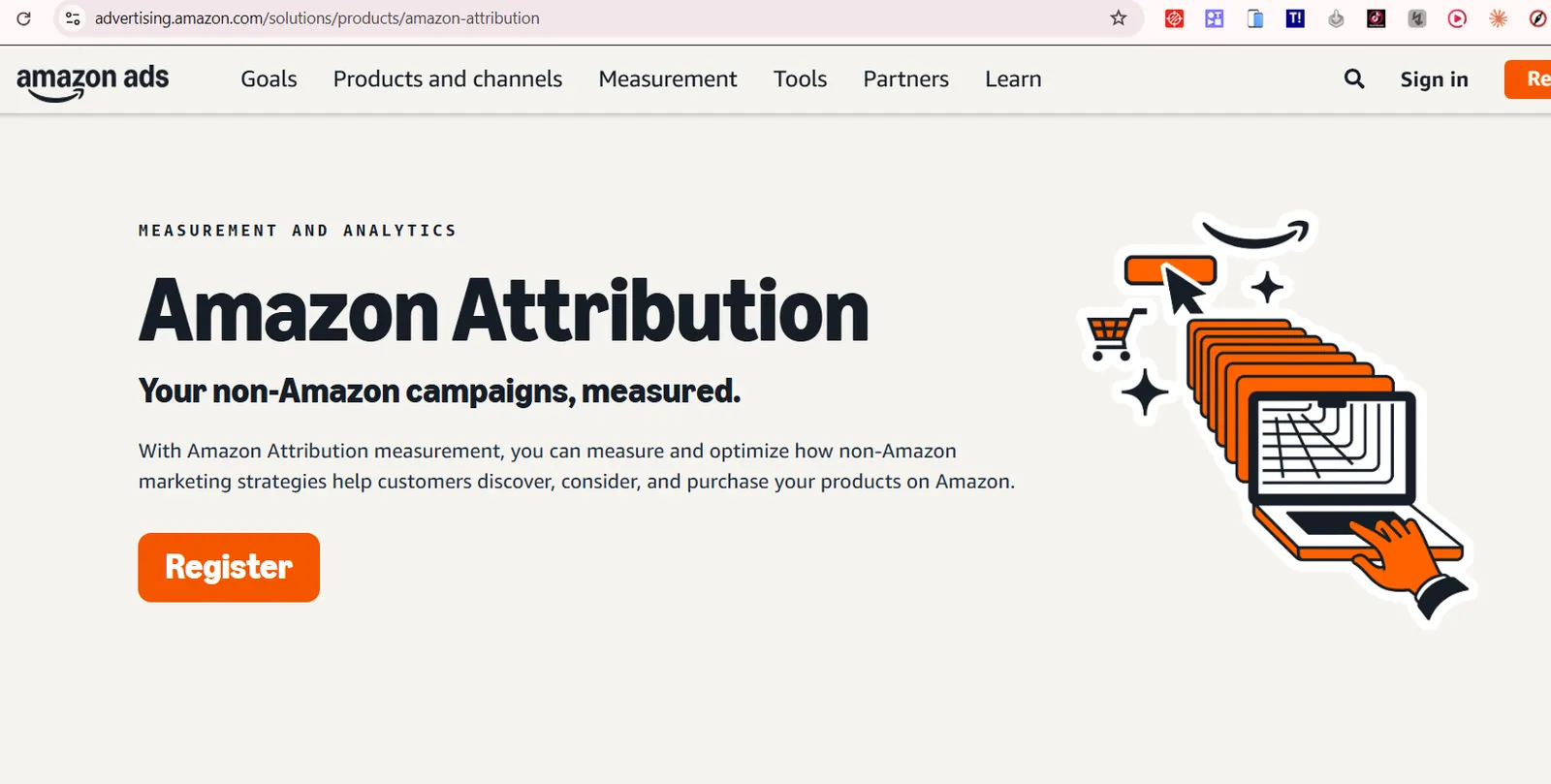
- For one month, give creators an Amazon Attribution link next to your site link, so you can see how many of their buyers pick Amazon.
- Have a clause to tell creators to update the link and code in the description few months to help stop site leakage.
Precedents:
We did a YouTube test and what we found on this test was that over 50% of revenue generated was being captured on Amazon. How HexClad Spent $700K on One Creator and Won Big, Marketing Operators, 2026, 64:29
creating more seamless pathways from inspiration to purchase Target Chief Digital and Revenue Officer Sarah Travis, on Target's creator programme, 6 May 2026
Caveat:
- Attribution is especially hard with influencers, so judge the program on total sales, and use codes and links only to compare creators with each other.
Resources:
- Amazon Attribution. See the sales your creator links send to your Amazon listing.
- GeoLift. Meta's free tool for testing, one region against another, whether your spend brought in sales you wouldn't have made anyway.
Are your creators reaching the same people your ads already reach?
Problem: Your ads have already found most of the people they can, so more spend mostly shows the same people your ads again (with diminishing returns). Bigger creators look like the fix, but a big channel's audience can be the same people too.
Diagnosis:
- Ask your ads team how often the same person sees your ads. Portland Leather Goods' CMO was choosing between reaching more people and showing people ads 30 or 40 times.
Solution:
- Ask buyers in your post purchase survey if this is their first order, and judge each creator on first orders, not total sales.
- Book creators in the niches your buyers live in outside your category. AG1's biggest creator niche is travel, with 209 videos, and health is only fourth, with 77.
- Move part of the budget from million subscriber channels to smaller creators in those new niches.
- Pick one group of people you aren't reaching yet, and book creators whose audience is that group.
- Run the creator videos that bring in the most first orders as ads, because they reach people your own ads haven't.
Precedents:
Is it that I think I'm going to spend way more money and I'm going to get to 70 million? Or am I going to spend way more money and my frequency goes to like 30 or 40? Operators Titans E002: Portland Leather Goods (with CMO MacCoy Merkley), Marketing Operators, 2025, 45:50
Antetokounmpo's core audience skews 18-34, a demographic where IM8 is currently under-scaled. Prenetics, IM8's parent company, announcing Giannis Antetokounmpo as a partner, 2 April 2026
Caveat:
- Our 24.5% comes from sponsored YouTube videos, so check your own mix on Instagram and TikTok.
Resources:
- Fairing Post Purchase Surveys (vendor page). A Shopify app that asks buyers how they heard about you, right after checkout.
Sourcing new influencers who are good is hard - you feel like you’ve already taken a lot of the good influencers
Problem: You already have a team of a few dozen top performers and the team is always looking for new influencers however, what then happens is you start reaching out to other influencers who are potentially less qualified, and then you try a couple videos, you see no performance, and you drop them
Diagnosis:
- Look at what percentage of influencers you sponsor that you haven't sponsored yet. This is very important because it will tell you your efficiency.
- Every influencer that you onboard incurs a fixed cost with the timing, getting to know their team, having to vet them, having to talk with them. If you are not continuing the relationship with them, then it's a huge waste.
- Think of it like hiring someone and then firing them a few months later.
- Count how many creators you booked again more than 60 days later.
- Industry averages: At $100 million and up it's 28%, against 40% for smaller brands.
- Compare your competitors rates. Ex. 81% of the creators LMNT first booked in 2023 got booked again, against 43% of AG1's.
Solution:
- Before the year starts, split the budget into two lists: creators you're booking again, and new ones you're testing.
- Follow thorough vetting procedures like looking at returning viewer count Write down what a new creator has to do to move onto the first list, before their first video goes live.
- Offer the creators on the first list a deal that runs a full year, instead of paying one video at a time.
- For the few creators you'd hate to lose, look at paying part of it in equity. Black Rifle Coffee says in its annual report that select influencers are awarded equity in the company.
- Work out what it costs your team to find and brief a new creator, and put that next to what they sold.
Precedents:
But then we also have to have the rest of our budget split in amongst enough creators cuz we don't necessarily know who's going to perform, who's going to, you know, resonate, and whose videos are going to do well. Influencer Marketing Strategy: Product Seeding, Building Partnerships & Measuring EMV, Marketing Operators, 2025, 16:10
Social following for the 2022 Sephora Squad grew a combined 99% over the course of the year-long program Sephora, on its year-long Sephora Squad creator programme, company newsroom, 21 June 2023
Caveat:
- Equity only makes sense for a handful of creators you plan to keep for years.
Do your paid team and your influencer team both count the same sale?
Problem: At your size, paid media, influencer and affiliate each have their own lead and their own dashboard. Add up what each one reports and it comes to more than you sold, and nobody can say what creators cost in total, because the costs sit in different budgets.
Diagnosis:
- Add up the sales each team claimed last quarter, and compare the total with what you actually sold.
- Count how many of your ads are creator videos. We found 40 partnership ads among 97 of AG1's own Meta ads.
- Look at where creator costs sit in your books. Vita Coco reports influencer costs in the same line as trade shows, product samples and event sponsorships.
Solution:
- Give each creator video one owner and one set of numbers, whether it runs on the creator's page or as an ad.
- Keep one sheet per creator with everything they cost: the fee, free product, commission, ad rights and the ad spend behind their videos.
- Once a quarter, have each channel lead defend their plan against the same sales number, not against their own dashboard.
- Settle arguments over credit with a region test or a media mix model, not with each tool's own tracking.
Precedents:
All the channel leads that report into me like our director of paid media, our influencer manager are doing the same thing. We meet on them. We discuss them. We kind of beat them up. Key Initiative Breakdown: When and how to diversify your media mix, Marketing Operators, 2026, 6:03
Caveat:
- Each tool's own numbers are still fine for comparing creators inside one channel.
Resources:
- Robyn. Meta's free, open source media mix model for splitting your sales across channels.
- GeoLift. Meta's free tool for testing, one region against another, whether your spend brought in sales you wouldn't have made anyway.
Can you prove every paid post says it's paid?
Problem: You work with hundreds or thousands of creators, affiliates and ambassadors, and nobody reads every post. A post that doesn't say it's paid is a legal problem, and public brands already list it as a risk.
Diagnosis:
- Count everyone who posts about you for money or free product. a.k.a. Brands says it works with approximately 25,000 influencers.
- Check who's left out. Traeger asks its community ambassadors to follow FTC rules, and says it doesn't regularly monitor what they post.
- Read your own risk list. e.l.f. Beauty gives influencers their own heading in its annual report.
Solution:
- Don't pay a creator's invoice until someone has checked that the live post is labelled as paid.
- Every month, check a random sample of posts and report how many missed the label, the same way finance reports an audit.
- Check every post from your biggest creators, and a sample from everyone else.
- Put gifted ambassadors and affiliates in the same check as paid creators.
- Put the right to ask for a fix, with a deadline, in every creator contract.
Precedents:
We generally require influencers to comply with the FTC regulations and regularly monitor what our influencers post. SharkNinja, annual report for the year ending December 31, 2023
While we ask community ambassadors to comply with the FTC regulations and our guidelines, we do not regularly monitor what our community ambassadors post Traeger, annual report for the year ending December 31, 2022
Caveat:
- A sample won't catch every post. It tells you how often it happens, so you know where to look.
Resources:
- Disclosures 101 for Social Media Influencers. The FTC's plain rules on when a paid or gifted post needs a disclosure.
- Add branded content restrictions and disclosure labels. YouTube's rules for marking a video as a paid promotion.
What happens to your brand if someone who represents it gets in trouble?
Problem: Founders, instructors, athletes and ambassadors carry your brand, and some of those deals aren't even written down. If one of them says the wrong thing, your customers and your investors hear about it at the same time.
Diagnosis:
- List everyone whose name or face is tied to your brand, paid or not.
- Check which of those deals are written down. Black Rifle Coffee says in its annual report that its deals with key influencers are often informal.
- Look at what it cost others. The companies that endorsed Tiger Woods lost an estimated 2% to 3% of their market value after his scandal.
Solution:
- Put every one of them on a written agreement that lets you end it and take down content quickly.
- Check their old posts and interviews before you sign, not after something comes out.
- For any campaign that leans on one person, pick a second face you could switch to.
- Write down who decides, and how fast, if one of them makes the news.
Precedents:
Our ability to maintain our brand image and leverage the goodwill associated with Ms. Winfrey’s name may be damaged if we were to lose her services or if the nature of our partnership changes. WeightWatchers (WW International), risk factors in its annual report for 2022, on its partnership with Oprah Winfrey
Actions by individuals or organizations associated with YETI (including Ambassadors and influencers) that are inconsistent with our brand values, whether on our platforms or theirs, could also harm our brand reputation and materially impact our business. YETI, annual report for the year ending January 3, 2026
Caveat:
- Most of these never go wrong. The point is to decide what you'd do before it does.
Will a celebrity grow your sales, or just ride a category that's already growing?
Problem: Other brands in your category signed a celebrity and their numbers look good. But it's hard to tell how much came from the celebrity and how much from the category growing anyway.
Diagnosis:
- Compare against the category. In the same year that celebrity tequila brands grew 16%, tequila as a whole grew 3%.
- Check a category that isn't booming. Celebrity gin brands declined by 1%, while gin grew by 4%.
- Look at what buyers pay for it. Drinks brands with a famous owner attached sold for a typical $408 million, and brands with nobody attached for $425 million.
Solution:
- Put a celebrity behind a category that's already growing, and don't expect one to fix a category that isn't.
- Before you sign, write down what the celebrity has to move and by when, so you can judge it afterwards.
- Hold back part of the pay until the results come in. When Diageo bought Aviation American Gin, it held back 45% of the price, paid over about 10 years.
- Test the message with creators first. If creators saying it don't sell, a celebrity saying it is a big bet.
Caveat:
- These numbers come from drinks, so check your own category before you lean on them.
Will your creator program survive a new CMO or a new agency?
Problem: A new CMO often reviews the agencies early. If the agency holds your creator list, your contracts and the relationships, all of it leaves with them, and the program starts again.
Diagnosis:
- Look at the timing. In the new CMO cases we studied, the ad agency went into review in 66 to 90 days, and a creator program took 12 to 25 months to set up.
- Check who holds the creator list, the rates, the contracts and the rights to the videos: you, or the agency.
- Look at what big brands are doing. Celsius opened its own in-house brand studio in September 2025.
Solution:
- Keep the creator list, rates, contracts and video rights in your own system, not the agency's.
- Write into every agency contract that the creator relationships and the data stay with you when it ends.
- Have one person in house who knows your top creators by name, even if the agency does the day to day work.
- Show a new CMO the creator results in their first 90 days, before they decide on agencies.
- If you do switch agencies, keep booking your best creators directly while the new one gets started.
Precedents:
We started to scale what has now become without a doubt at least on The Tick Tock channel the largest in-house influencer agency that I would think exists Secrets to "Overnight Success" at Bloom Nutrition | Greg LaVecchia Interview, Joshua Schall, 2023, 18:05
Caveat:
- An agency can still do the work well. What matters is that you own what it builds.