
best-advertising-agency · agency-selection
What Is the Best Advertising Agency for Your Brand in 2026
We catalogued 420 influencer marketing agencies and ranked 206 paid ads shops on a 100 point rubric. Here is the narrowing process behind every pick, agency by agency, pool by pool.
The best advertising agency is the specialist that matches your channel, your niche, and your budget, and we scored 626 agencies to find them.
We catalogued 420 influencer marketing agencies, ranked 206 paid ads shops, and tried to contact more than a hundred of them. The most interesting things we found, up front:
- All 14 niche winners are specialists. Not one do everything generalist took a single niche.
- 22 of the 420 agencies blocked their own contact forms, 16 published no business email anywhere on their site, and 7 had dead websites.
- 10 of the 21 gaming agencies turned out to be talent agencies selling their own streamers, which is a conflict of interest, not a service.
- Only 1 of the 14 winners, fintech shop Flake Agency, says anything at all about how it handles regulation.
- Only 1 of the 14 publishes its pricing. Every other winner makes you book a call to hear a number.
- Movers+Shakers took e.l.f. Beauty from the number 8 brand on TikTok to number 1, by their published account, the single loudest result in the whole data set.
The narrowing, in numbers. 420 agencies went into the master list, each niche pool ran 7 to 22 candidates, 54 survived as shortlist backups across all niches, and 14 came out winners. The rest of this post shows that narrowing agency by agency, so you can run the same test on any shop that pitches you. It runs long on purpose, the process is the point.
Why there is no single best advertising agency
An agency that is brilliant at Google Ads has no edge in creator sponsorships, and the biggest creator agency in gaming knows nothing about your beauty launch. So the useful question is narrower, which agency is best at the one channel that moves your number, in the niche where your buyers live.
Two hard filters shaped the whole ranking before a single point was scored, and they are worth stealing.
We dropped any shop with more than 50 employees, because past that size your account is usually handed to a junior team while the senior people who pitched you move on. And we dropped agencies outside our target market, because ad rules, platforms, and pricing are local.
Best is a matching problem, so filter for channel, niche, and size fit before you compare anyone on talent.
If your channel is creators, our guide to picking an influencer agency by niche goes deeper on the matching step.
How we scored 626 agencies
The process ran in the same order for every agency, so the scores are comparable.
Step 1, the sweep. We pulled candidates from open web searches, published agency lists, city by city sweeps, and the client pages of agencies we already knew, then deduplicated everything into one master list of 420 influencer marketing agencies. A second run collected the paid ads shops the same way.
Step 2, the same facts for everyone. Each agency got logged on identical fields, niche, type, size, location, pricing, named clients and results, specialty, how it handles regulated categories, whether it has a media kit, and a 0 to 100 grade on its creator talent page where one existed. Ten agencies got a full teardown on top of that.
Step 3, the score. Everything that survived the hard filters was scored out of 100 points across six things.
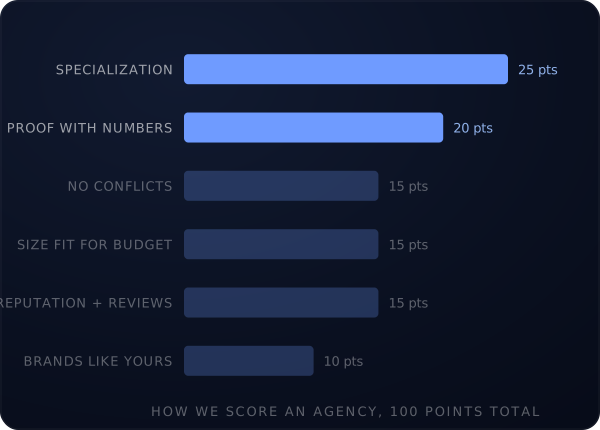
| What we score | Points | What it means in practice |
|---|---|---|
| Specialization in your channel | 25 | The agency does your channel all day, it is not one line on a services page |
| Proof with hard numbers | 20 | Named clients with published results, like a percent lift, never logo walls |
| No conflict of interest | 15 | They are not also selling you the media or repping the other side of the deal |
| Size fit for your budget | 15 | 5 to 50 people, senior enough to matter, small enough to care |
| Reputation and reviews | 15 | Review ratings, partner badges, and mentions across independent lists |
| Experience with brands like yours | 10 | They have shipped work for stores and DTC brands, including regulated ones |
Step 4, the contact test. It taught us the most while costing nothing.
Of the 420 influencer marketing agencies we catalogued, 22 blocked their own contact forms, 16 published no business email at all, and 7 had dead websites.
When we did get through, responsiveness was decent, 45 of the 105 agencies we contacted wrote back. But if an agency is hard to reach before you are a client, assume it gets worse after the contract is signed.
Score any pitch on these six things and demand published numbers for the proof line, a logo wall is not proof.
The best advertising agencies by niche
These are the 14 niche winners from the 420 agency run. For each one, the pool it beat, the cut that emptied that pool, why it won, and the catch we logged. The results are each agency's own published numbers, we did not run these campaigns.
Crypto and Web3, Coinbound
The pool. 22 crypto and Web3 agencies, the biggest specialist pool in the whole list.
The cut. Most published no campaign results at all, so the proof score emptied the pool fast, only 4 others survived as backups.
Why they won. More than 900 clients logged, a network of more than 500 crypto creators, and published campaign results with numbers attached. Nobody else in the 22 had all three.
The catch. No public pricing, the $15,000 to $75,000 or more per month figure in our sheet is a third party estimate, so budget talks start blind.
Finance and fintech, Flake Agency
The pool. 16 finance and fintech agencies.
The cut. Almost all of them do finance as one lane among many. We kept cutting until one exclusive specialist was left.
Why they won. An exclusive roster of more than 80 financial influencers, named fintech clients like Colibid, Equito, and Rand App, and it is the only winner of the 14 that states how it handles regulation.
The catch. Its talent page graded 35 out of 100, so ask to see actual creators before you sign anything.
Beauty, SEEN Group
The pool. 15 beauty agencies, and 4 of them turned out to be talent agencies that rep creators rather than run campaigns.
The cut. Talent agencies sell you their own people, which is the conflict of interest line in the rubric, so they dropped first. Client proof separated the rest.
Why they won. A pure play beauty collective with Clinique, Fenty Skin, and Shiseido on the published client list, the strongest brand proof in the pool.
The catch. Our contact test could not reach them, no working public form or email. Plan your timeline around a slow first conversation.
Gaming, Cloutboost
The pool. 21 gaming shops, the messiest pool we scored. 10 of the 21 were talent agencies repping streamers.
The cut. A shop that reps streamers is selling its own people, and none of those 10 published campaign results for brands. Conflict plus no proof cut the pool in half in one pass.
Why they won. Gaming only, its own database of creators in the 500K to 1.3M follower range, and published performance metrics, which almost nobody in gaming shows.
The catch. No public pricing here either, and it does not show a gradeable talent page, so make them walk you through named creators.
Esports, GG Talent Group
The pool. 15 esports agencies, with the same talent agency crowd as gaming, 4 of the 15.
The cut. An exclusive roster can be a conflict, and GG runs one, more than 100 Twitch and YouTube streamers. It offset that with the one thing nobody else in the 420 does, published pricing.
Why they won. A 20 percent commission on deals, stated in public, founder led with a verified contact, and partners like Team17 and Guillemot on record. That one line of pricing transparency moved it up the board more than any logo could.
The catch. Its talent page graded 40 out of 100, mid pack, and the roster is exclusive, so what you see is all there is.
Sustainability, Dandelion Branding
The pool. 17 eco agencies, one of the bigger pools, green is a crowded pitch.
The cut. Most eco marketing we read was a sustainability page bolted onto a general shop. We cut everything that was a page instead of a practice.
Why they won. Built around anti greenwashing with its own vetted eco creator network. In a niche where one wrong claim is a regulator letter, that focus is the product.
The catch. No published campaign numbers in our sheet, so make them show two named results before you sign.
Fitness and wellness, Gymfluencers Agency
The pool. 21 fitness and wellness agencies, tied with gaming for the biggest pool.
The cut. Scale claims without proof. Most shops claimed big networks and could not show the creators. We checked that the creators Gymfluencers showcases exist and post, they do.
Why they won. Fitness exclusive, with more than 3,000 creators and 300 coaches and a combined audience it puts above 505 million followers, the only claim of that size that survived a spot check.
The catch. Those follower totals are self reported, treat them as directional, not audited.
Entertainment and music, Creed Media
The pool. 17 entertainment and music agencies, 4 of them talent agencies.
The cut. In music, everyone claims access. We scored on which buyers came back, because repeat clients are proof that cannot be faked on a website.
Why they won. Spotify, Sony Music, and Universal on the client list, the hardest buyers in music, returning. A Gen Z social specialist by build.
The catch. That Gen Z focus is the whole tool. If your buyer is over 35, this is the wrong pick.
Parenting and family, BSM Media
The pool. 12 parenting agencies.
The cut. Track record ended this one early, nobody else was close on any of the three numbers that matter.
Why they won. 25 plus years in mom marketing, a network it puts at more than 45,000 mom creators, and more than 3,400 campaigns logged.
The catch. No public pricing, and the network skews to moms specifically, so ask first if your buyer is anyone else.
Fashion and apparel, Stylophane
The pool. 14 fashion agencies.
The cut. Most fashion shops do gifting and hope. We cut everything that could not show paid machinery.
Why they won. More than 20 years in fashion and beauty paid social, plus the whitelisting and affiliate mechanics fashion campaigns actually run on.
The catch. No gradeable talent page, so ask to see the creator bench, not just the client logos.
Gen Z and TikTok, Movers+Shakers
The pool. 7 agencies, the smallest pool in the list. TikTok native shops are still rare.
The cut. Small pool, one loud result. Nothing else came close to a named, before and after outcome.
Why they won. Their published account of taking e.l.f. Beauty from the number 8 brand on TikTok to number 1. We looked for a comparable result anywhere else in the 420 and did not find one.
The catch. One flagship result carries the pitch. Ask for a second named client with numbers before you sign.
B2B and SaaS, Cherry Lane
The pool. 14 tech and B2B agencies.
The cut. Most talk about LinkedIn, few run creators there. We cut everyone whose proof was reach instead of pipeline.
Why they won. LinkedIn first with B2B creators, and its Typeform program cites more than 1,300 leads, a pipeline number, which is exactly what a B2B buyer should demand.
The catch. LinkedIn first is also LinkedIn mostly. If your buyers are not there, neither is the value.
Food and beverage, Foodie Tribe
The pool. 9 food agencies, a small pool for a huge category.
The cut. Enterprise operations. Feeding a global chain and an app marketplace at once breaks most small shops, so tested operations decided it.
Why they won. More than 3,000 vetted food creators, with McDonald's, DoorDash, and GOYA on the client list.
The catch. No public pricing, and no gradeable talent page, ask for the bench.
Travel, Travel Mindset
The pool. 11 travel agencies.
The cut. Destination marketing is its own discipline, public sector buyers, long timelines. It was the only shop we found that lives there full time.
Why they won. A destination specialist whose Visit Maine campaign cites 21 million impressions.
The catch. Built for destinations and tourism boards. A consumer travel product may not fit their playbook, ask for a comparable client first.
So when you shortlist from these, ask for the pricing model in your first email. The answer, and how fast it comes, filters the list before you sit through a single pitch call.
The best paid ads agencies we found
The second run ranked 206 paid ads shops with the same rubric, for brands whose main channel is Google, Meta, or Amazon rather than creators. Twenty were cut by the hard filters before scoring. Here is how the top five earned their scores.
Inflow, scored 91. Topped the board on the cleanest proof line in the pool, KEH Camera grew ad revenue 413 percent year over year by their published numbers, a named client with a named percentage.
Accelerated Digital Media, scored 90. The one we would point regulated brands at, it specializes in telehealth and HIPAA constrained work and cites 196 percent revenue growth for NOCD. Hard category, hard number.
Black Propeller, scored 90. Proves scale differently, it manages more than $100M in annual ad spend and is honest about who it is for, with a $10,000 per month minimum.
Flighted, scored 90. Sits in the top 1 percent of Meta agencies by spend and cites a 13 percent CPA drop for Cat Person, a result in the metric that actually pays bills.
Matchnode, scored 90. Rounded out the five way tie at the top.
If paid ads is your main channel, shortlist from this top five and ask each shop for one named result in your product category, the same proof test we scored them on.
The red flags our research kept finding
Reading 626 agency websites in two research runs surfaces the same problems over and over, and they are the things a pitch deck will never tell you.
Almost nobody talks about compliance. Of our 14 niche winners, only Flake Agency said anything about how it handles regulation. If you sell supplements, CBD, telehealth, alcohol, or anything else age gated or regulated, the agency's silence is your risk, because fines land on the brand, and the ad rules keep tightening.
Talent pages are weak even at good agencies. We graded creator roster pages 0 to 100 where they existed, and the niche winners that had one scored 35 and 40. The lesson, a strong client list does not mean the agency can actually show you the creators you would be buying.
Pricing is hidden by default. Of the 14 niche winners above, only GG Talent Group in esports publishes its model, a 20 percent commission on deals. Everyone else makes you book a call to hear a number.
This is the part we built our own shop around. We work the creator channel for DTC brands in regulated niches, cannabis, supplements, telehealth, sexual wellness, and age gated products, and compliance is the first check on every creator we put in front of you, never a footnote. If that is your category, the vetting and the rule keeping is the work we take off your plate.
The agency's website tells you more than its pitch, check the compliance page, the talent page, and the pricing page before you book the call.
How to choose your agency this week
Here is the same process we used, cut down to an afternoon.
First, write down your one main channel and your niche, and only shortlist specialists in that exact pairing. Our data says the specialist wins every niche, so a generalist needs an extraordinary reason to make your list.
Second, score each shortlisted agency out of 100 with the six weights above. Ask each one for two named clients with published numbers, and treat a refusal as a score of zero on proof.
Third, run the contact test. Email them, use the form, and time the reply. Remember that 22 of 420 agencies blocked their own forms, you want the ones that answer in a day.
Fourth, ask the compliance question even if you think your product is safe. The answer tells you how carefully the agency thinks about your money and your legal exposure.
And if you are budgeting the campaign itself, our influencer marketing cost guide breaks down what the creators cost once the agency question is settled.
If your main channel is creators and your product is regulated, that is exactly our lane. Tell us about your brand and we will send back a vetted, priced creator shortlist, with the compliance already checked.
Frequently asked
What is the best advertising agency in 2026?
There is no single best advertising agency, the best one is the specialist that matches your channel and niche. We catalogued 420 influencer marketing agencies and ranked 206 paid ads shops, and in every niche the winner was a focused specialist, like Coinbound for crypto or SEEN Group for beauty, never a do everything generalist.
How much does a good advertising agency cost?
Pricing models vary widely. Coinbound runs an estimated $15,000 to $75,000 or more per month for crypto work, Black Propeller asks a $10,000 per month minimum ad spend, and GG Talent Group charges a 20 percent commission on sponsorship deals. Always get the model in writing before you compare quotes.
Should I hire a big agency or a specialist?
Our ranking gives specialization 25 of 100 points, the single biggest factor, and it drops any shop over 50 employees before scoring even starts. A specialist that lives in your channel all day beats a big generalist that bundles your budget into a wider media plan.
How do I vet an advertising agency before signing?
Ask for named results with numbers, like Inflow's 413 percent ad revenue growth for KEH Camera, then check how reachable they are. Of the 420 influencer agencies we catalogued, 22 blocked their own contact forms, 16 published no email at all, and 7 had dead websites.
What is the best advertising agency for regulated products?
Very few agencies state how they handle regulated categories. Of the 14 niche winners in our research, only one, fintech specialist Flake Agency, said anything about compliance. For cannabis, supplements, telehealth, and other regulated products, ask the compliance question first, it is where fines start.