
Celebrity Endorsement Examples, What Worked and What Blew Up
McDonald's put 20 million dollars of sales through an app to prove one meal worked. Bud Light lost 40 percent of its sales by answering a boycott badly. Both stories, and twenty more, in question and answer form with the sources named.
Senior Partnerships Manager · August 10, 2026 · 18 min read · Updated August 11, 2026
Snapchat ran one bad ad about Rihanna and roughly 1 billion dollars of market value came off the stock. McDonald's ran one meal with Travis Scott and booked over 20 million dollars in sales in a few weeks.
This is part two of our celebrity partnerships series, and it is the examples half, the campaigns that returned money, the campaigns that cost it, and the measurement each brand used to know the difference.
Every answer below is lifted from our own research notes, and where a number came from somewhere, the source is named underneath it. The last question is the list of numbers in here we would not put in front of a client without checking first.
Campaigns the brand could actually measure
How did McDonald's track the Travis Scott meal?
A. With the app and the sales data, on purpose.
McDonald's had not named a menu item after a celebrity in 30 years, not since Michael Jordan, when it launched the Travis Scott Meal in September 2020, and it specifically picked a celebrity who was already a documented fan of the brand. It measured the impact through app based tracking and sales data, the campaign brought over 20 million dollars in sales in the first few weeks, and the company reported a 15 percent rise in quarterly revenue largely credited to the promotion.
Source, Jobaaj, Case Study, How McDonald's Travis Scott Meal Campaign Became a Success
How did Dunkin measure Charli D'Amelio?
A. It built the measurement into the product.
Dunkin launched "The Charli", a signature cold brew, and pushed purchases through its own app. Day one brought a 57 percent jump in app downloads and a 20 percent sales lift across all cold brew coffees, followed by a 45 percent jump the next day.
To show cause and not just correlation, analytics firms like StatSocial ran incrementality testing on social audience data, comparing people organically exposed to Charli's content against the general population. Before the partnership her followers spent 7 percent more than the average consumer at Dunkin. During the campaign that went to 44 percent more, which isolates the lift the endorsement itself created.
Source, StatSocial, an influencer attribution case study on Dunkin and Charli D'Amelio
How do you separate one celebrity's effect from the whole market?
A. With industry wide retail data and a long enough window, which is what researchers did to Nike.
Using retail data from Golf Datatech they isolated the Tiger Woods effect, and found that from 2000 to 2010 his endorsement brought Nike roughly 4.5 million new customers and an extra 60 million dollars of profit in the golf ball division. Even through the bad publicity after his personal scandal, keeping the relationship left Nike about 1.6 million dollars better off than dropping him would have. It is the clearest example of analysis separating a celebrity's impact from the market moving on its own.
Source, a Carnegie Mellon University study built on Golf Datatech industry retail data
How do you prove the campaign caused the sales?
A. With an incrementality test, not an attribution report.
Large brands use geo holdout tests, for example turning Meta ads off in half of the target markets for two weeks and watching what happens to direct traffic and organic search. It usually shows that 10 to 30 percent of the conversions being credited would have happened anyway.
The formula that matters is net influencer ROI, which is incremental revenue minus total program cost, divided by total program cost. Total program cost has to include creator fees, agency retainers, seeding costs, and the compliance work, or the number is fiction.
How should a big brand split the influencer budget?
A. Like a portfolio, in three buckets.
- 40 percent performance. Micro and nano creators with trackable affiliate links, aiming at a 2.0 times return within 90 days.
- 35 percent brand and consideration. Mid tier creators and podcasts, measured with brand lift studies, aiming at 8 to 18 percent lift, plus deal velocity.
- 25 percent experimental. New platforms, new formats, new audience graphs.
What are the value metrics people quote?
A. Three of them come up constantly.
- Q Score, or Q rating, the long standing measure of how appealing and familiar a public figure is.
- EMV, earned media value, which puts a money figure on the organic exposure a brand gets from the partnership, meaning press coverage, organic shares, and fan discussion.
- MIV, media impact value, which is a proprietary algorithm owned by Launchmetrics.
Source, Launchmetrics owns and publishes the MIV methodology.
Brands that built the partnership into the product
What is Alo Yoga doing, and why does it keep coming up?
A. Volume, consistency, and a celebrity muse model, with no venture funding behind it.
Alo scaled to an estimated 2 billion dollars in revenue by building a creator ecosystem nobody has matched. In a 12 month period across 2025 and 2026 the brand sponsored 29,800 posts across 10,900 unique influencers.
The program is heavily Instagram focused, 84.9 percent of sponsored posts, and deliberately spread across audience sizes rather than leaning on mega celebrities, 28.7 percent of partners average 10K to 50K views and 26.6 percent average 1K to 5K views. That surround sound approach builds lifestyle legitimacy instead of pushing product, and it blends in person events with digital amplification.
It shows up in market share. According to ConsumerEdge data Alo's direct to consumer share went from 8 percent in September 2025 to 12 percent in October and 14 percent in November, a three month gain taken almost entirely from Lululemon.
Source, the market share figures come from ConsumerEdge data reported by Stocktwits, March 2026 . The 29,800 posts and 10,900 influencers come from Modash, Alo Yoga's Influencer Marketing Strategy, July 2026.
What is Ritual doing differently?
A. It spent the funding on credibility instead of only on acquisition.
Ritual used its 138 million dollars of venture funding to build a moat out of clinical proof, committing 5 million dollars to human clinical trials on its finished formulations and building a "Made Traceable" supply chain.
Source, Ritual's own statement on human clinical trials by 2030, plus Incrementum Digital, Successful Supplement Marketing Strategy Examples, April 2025. The 138 million funding figure traces only to a Business Model Canvas summary article, which is a weak source, so confirm it before quoting.
That rigour pays back in marketing efficiency, because publishing peer reviewed data and partnering with science fluencers, meaning MDs and registered dietitians, is what lets Ritual hold a 20 to 30 percent price premium over the legacy brands.
How did Oura get to an 11 billion dollar valuation?
A. With a tiered influencer strategy rather than traditional advertising.
- The organic celebrity catalyst. When people like Prince Harry and elite athletes were seen wearing the ring on their own, it was huge validation nobody paid for.
- The B2B2C approach. Partnering with organisations like the NBA gave institutional credibility that flowed down to consumers.
- Tiered activation. Mega influencers for broad awareness, macro influencers for category credibility in tech and wellness, and micro and nano influencers for trust inside local communities.
How did Stanley find a new audience?
A. It did not start it, its customers did.
Stanley is a century old brand that found a new demographic when the founders of The Buy Guide, an online shopping blog run by women, fell in love with the Quencher and championed it to their female audience.
How did Gymshark break in?
A. From nothing. It was founded in a garage in 2012 by a 19 year old, and it had to break into a fitness apparel market dominated by Nike and Adidas.
Which shelves a celebrity has already taken
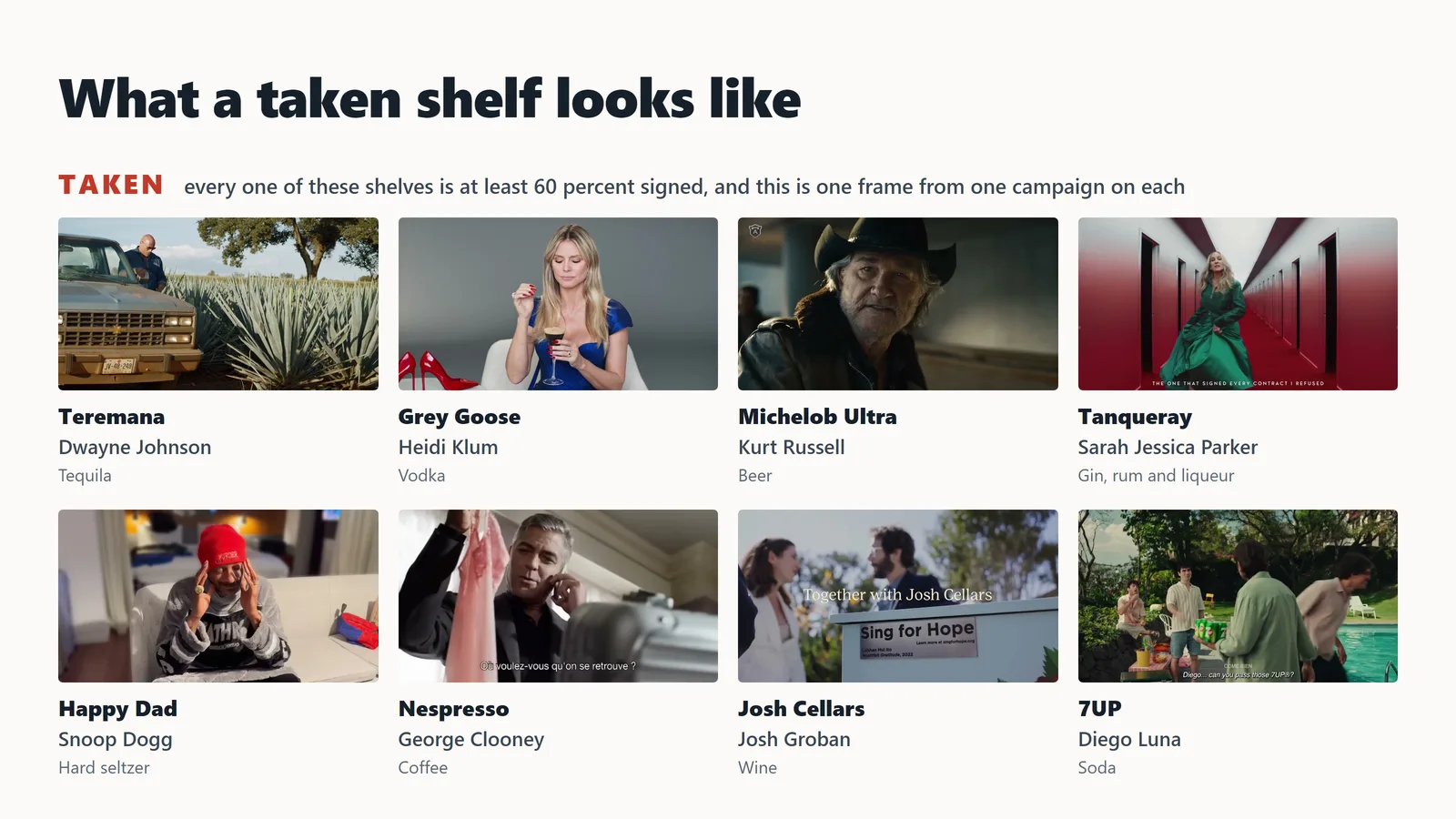
Every example above is one campaign, and the question sitting underneath all of them is whether a famous name is even available in your category any more, so we counted it for drinks, where 278 companies sit across nineteen shelves and 138 of them already have a famous person attached.
The alcohol shelves went first and they went completely, every one of them at sixty percent signed or higher and vodka at every single company we hold, which is easiest to see when you put one frame from each of those campaigns beside each other.
The bottom row is the part worth reading twice. Hydration and sports drinks, protein and greens, adaptogens and kombucha hold 67 companies between them, and only 11 of those companies have anybody famous attached at all.
The different ways to spend the money
Do influencer trips actually pay for themselves?
A. On the evidence, yes, and two brands prove it at different scales.
Revolve built a 1.2 billion dollar business with influencer marketing at the centre of it. Instead of paying per post, it pays in experience, creating exclusive trips, and up to 70 percent of its sales are reported to come from influencer partnerships, which makes creator commerce the main growth engine and not a side channel.
Source, Opefir Agency, How Revolve's Influencer First Marketing Model Changed Fashion Retail
Tarte hosts lavish trips, to places like Dubai and Bora Bora, and documents them heavily so the content plays like a bingeable reality series. A recent trip to Key Largo generated 2.5 million dollars in media impact value, part of the 180 million dollars of MIV Tarte generated from influencers in 2025, which was 75 percent of its total.
Source, Ilchi, L., How Tarte's influencer marketing strategy fuels growth, Revenue Brew, 2026
There is a quieter version too, the exclusive preview or dinner, an intimate gathering for top clients, editors and a few influencers to see a collection early, which suits luxury brands, rewards loyalty and earns high quality editorial coverage. KIKO Milano's "Beauty and the Book" dinner is the example.
Is it better to spend the whole budget on one influencer?
A. Sometimes, and two examples say so.
Instead of sending out lots of PR mailers, Swan Beauty sponsored the bachelorette party of a single influencer, Bridgette Pheloung of Acquired Style, in St. Barts, with free products, a private jet and luxury goodie bags. That one concentrated effort took Swan Beauty's Instagram following from under 3,000 to over 4,400 in days, with a lot of awareness on top.
Rhode invited creators to a ski resort in Big Sky, Montana to promote its winter collection, and the trip matched a cosy winter getaway to the brand's own idea of reboot and reset, so the creators could make content that fit the audience without forcing it.
Can I pitch a brand on co creating a product with influencers?
A. Yes, and there is a simple version of it to sell.
Bringing influencers into product development is a strong way to build loyalty, because a creator who helped shape a product is invested in it succeeding.
The actionable version is a program where selected influencers test formulas or prototypes and give feedback that genuinely changes the final product.
Skincare brand Experiment already does this with its "Lab Rat" program, where real customers and micro influencers test formulas and give detailed feedback that shapes the final version.
What is the seeding play, where nobody signs anything?
A. Luxury and lifestyle brands have used a covert, zero contract tactic for years, they seed product to celebrities through stylists and let the paparazzi do the work.
The mechanics are simple.
- The brand sends product to a celebrity seeding agency in LA or New York.
- Celebrity stylists visit the showroom and take items for their clients.
- The celebrity wears the product in public and gets photographed.
- The brand's PR team takes those paparazzi photos and pitches them to editorial outlets as trend stories.
Car brands do it, Audi has been known to seed free leases, apparel brands at every price tier do it, and Airbnb seeds free stays at key properties. The celebrity never signs a contract and never posts an #ad, and the brand still gets placement that looks organic. The FTC has been scrutinising this more, and it is still widespread.
What is the Liquid Death and Ryan Reynolds approach to attention?
A. Use celebrities to earn media instead of buying impressions, and let the audience in on the joke.
Liquid Death, canned water, built a whole philosophy on using celebrities in ways that generate earned media rather than paid impressions.
Ryan Reynolds built a marketing philosophy on self deprecating, fourth wall breaking humour that treats the audience as smart enough to know they are being marketed to, and makes that the joke.
For Aviation Gin he released ads that openly mocked advertising conventions, responded in real time to cultural moments, most famously a reply ad to the Peloton wife commercial that went viral within days of the original, and used his own personal Twitter and social presence as an extension of the brand.
For Mint Mobile he ran ads that openly admitted the company was small and cheap, and framed that as the feature, we cannot afford to waste your money on expensive ads, so we pass the savings on to you.
How they blow up
Why do celebrity campaigns fail?
A. If the upside is a ten times return, the downside is brand dilution, negative return, and a public relations disaster.
The main cause is the authenticity gap. Today's consumers, especially younger ones, can spot a purely transactional relationship, and if the celebrity clearly does not use the product, the endorsement fails.
The foundational promise of influencer marketing is that it feels more genuine than advertising, an influencer recommending something feels like a friend's advice rather than a billboard, and everything breaks when that stops being true.
Why do restrictive briefs backfire?
A. Because control is the trade.
One of the biggest pain points for creative directors is the loss of control over the brand story. Traditional advertising lets you oversee every visual and every word, and influencer marketing requires handing some of that over to the creator.
When briefs are too restrictive the content feels staged and does not land with the creator's audience, which defeats the point of the collaboration. When creators get too much freedom, the brand's message or look gets diluted or misrepresented. Both failure modes are real, and the job is holding the middle.
What happens when a creator's own history contradicts the message?
A. It becomes the story, which is called narrative contradiction.
Boots UK partnered with the wholesome influencer Zoella on a 50 pound Christmas advent calendar. Consumers mocked it as overpriced and low quality, then it got worse when old tweets surfaced in which Zoella made classist remarks.
Kim Kardashian promoted a morning sickness pill on social media without disclosing the possible side effects, and the FDA stepped in, which put the health implications and the legal violations in the content on the record.
What happens when a brand uses a crisis or a cause to sell?
A. Some of the most damaging failures happen when a brand or an influencer tries to make commercial use of a serious social, political or cultural situation.
Shein's factory tour in 2023 is the most cynical example. The Chinese fast fashion brand had been facing sustained allegations of labour abuses, including 18 hour workdays, wages below minimum wage, and hazardous materials, so it flew a group of Western influencers to tour a spotless innovation centre in Guangzhou. The backlash was immediate and severe, audiences read the tour for exactly what it was, a public relations exercise using influencer credibility to whitewash documented labour abuse. The influencers were criticised not only for the content but for accepting the invitation at all, and the campaign damaged their reputations while pulling fresh attention back to the allegations.
Source, Allen and Gerritsen, The 4 Biggest Influencer Marketing Flops of 2023
Poppi's Super Bowl vending machines are the softer version of the same mistake. Ahead of its Super Bowl commercial the prebiotic soda brand sent enormous custom branded vending machines to 32 influencers and fans of the brand, estimated at 10,000 to 25,000 dollars each, though Poppi disputed the higher figure. The first response was positive and the videos got millions of views, then the backlash arrived, with consumers asking why expensive gifts went to wealthy influencers instead of fans, hospitals, schools or community groups. Competitor Olipop amplified it, commenting on the likely cost of the machines and offering its own more modest giveaways. Founder Allison Ellsworth replied on TikTok, pointing out that the brand had donated millions of cans to nonprofits while admitting that work had never been publicised, and the response itself brought more criticism.
What happens when nobody discloses?
A. The regulator makes an example of the brand.
Lord and Taylor in 2016 was the first major FTC action against a fashion brand for disclosure failures. It paid 50 fashion influencers to post photos wearing the same paisley dress on the same weekend, which made it look like an organic trend, and none of them disclosed that they had been paid or given the dress. The FTC charged the brand with deceptive advertising and settled on terms that barred it from presenting paid endorsements as independent opinions.
Source, the FTC press release on the Lord and Taylor settlement, March 2016
Can the response to a controversy be worse than the controversy?
A. Yes, and Bud Light is the clearest case there is.
The initial controversy in 2023, a conservative boycott over the partnership with transgender influencer Dylan Mulvaney, was predictable and manageable. The response is what turned it into a catastrophe.
The brand's first statement called the partnership "one can, one influencer, one post and not a campaign", which read to everyone as the company distancing itself from Mulvaney. It then put its VP of Marketing on leave, hired conservative political consultants, and launched a new campaign featuring Clydesdale horses in rural American landscapes. That alienated the LGBTQ+ community, a loyal Bud Light audience for decades, and it did not satisfy the boycotters, who carried on.
Mulvaney said publicly that Bud Light never reached out to support her, "For a company to hire a trans person and then not publicly stand by them is worse, in my opinion, than not hiring a trans person at all." The brand managed to alienate both sides at once, and by February 2025 sales were still around 40 percent below where they were before the boycott.
Source, Dylan Mulvaney's own public statement. The 40 percent sales figure comes from Allen and Gerritsen and the Bud Light boycott record
Snapchat and Rihanna in 2018 is the fast version of the same lesson. Snapchat ran an ad asking users whether they would rather "Slap Rihanna or Punch Chris Brown", a reference to Brown's 2009 assault of Rihanna. She responded publicly, called the ad disgusting, and told her followers to delete Snapchat, and roughly 1 billion dollars of market value came off the company's stock.
Source, DeepDive, 10 Failed Influencer Marketing Campaigns of All Time, August 2025
The numbers we would not repeat to a client
Which numbers still have no source at all?
A. Five, after tracing every claim back through the Manus research reports these notes came from. Everything else in this doc now names where it came from.
- The 40, 35 and 25 percent portfolio split, and the 8 to 18 percent brand lift target.
- Oura's 11 billion dollar valuation and the tiered influencer breakdown under it. The valuation itself is confirmed elsewhere as a 900 million dollar Series E in late 2025, the influencer story is not sourced.
- The Erewhon smoothie economics, the one dollar royalty and the ingredient inclusion fees.
- The Stanley and The Buy Guide story.
- The Swan Beauty bachelorette trip and the follower numbers around it.
Three numbers that have a source, and it is a weak one
- The 30 percent valuation premium. Both sources are promotional, a venture studio blog and a lifestyle magazine, so treat it as directional and never put it in a deck as fact.
- Ritual's 138 million dollars of funding. Traces only to a summary content site, not to Ritual or to a funding database.
- The 10 to 30 percent of conversions that would have happened anyway. The report cites an article about acquisition cost by channel, which is not about geo holdout testing, so the citation does not actually support the claim.
These five plus the three weak ones are the only things in here I would not put in front of a client without checking first.
Where We Come In
The through line in every campaign above is that the brands who could measure the thing kept doing it, and the brands who could not measure it argued about whether it worked.
We build the measurement into the deal before it is signed, which means a baseline set before launch, a holdout where one is possible, and a total program cost that includes the agency and the compliance work rather than the fee alone.
If you are earlier than that and still working out who signs it off and what it costs, part one of this series covers how a celebrity endorsement actually gets done.
Send us the names you are considering and we will tell you which ones survive a proper check. Speak with us when you want the reading done before the money moves.
Reading loop
Frequently asked
What is a celebrity endorsement?
A paid agreement where a well known person publicly supports a product so their audience associates the two. It is a licence of their reputation for a set time, which is why the contract matters as much as the fee.
Do celebrity endorsements still work?
They work when the pairing is believable and the brand keeps showing it. One post from a famous person who has never touched your category is expensive noise. A named partner used across a year of campaigns is what moves recall.
Are celebrity endorsements worth it for a large brand?
They are worth it when you need reach and credibility faster than you can build them, and when you can reuse the content in paid media. If the budget only covers the fee and not the usage, the money is better spent on a group of mid tier creators.
Do celebrities have to use the product?
In the United States the FTC expects an endorser to be a real user of what they promote, and the disclosure has to be clear. For a regulated product you also need claim review before anything is posted, because the brand carries the liability, not the person.
How do you prove a celebrity campaign caused the sales?
With an incrementality test, not an attribution report. Large brands use geo holdout tests, for example turning Meta ads off in half of the target markets for two weeks and watching what happens to direct traffic and organic search. It usually shows that 10 to 30 percent of the conversions being credited would have happened anyway.
Why do celebrity campaigns fail?
The main cause is the authenticity gap. Today's consumers, especially younger ones, can spot a purely transactional relationship, and if the celebrity clearly does not use the product, the endorsement fails.