
Influencer marketing Q&A, the condensed version
Regulation, and it is a harder stop than money. Three brands told us the channel is closed to them outright.
Founder · September 16, 2026 · 25 min read
Should you do this at all
What stops a supplement brand using creators entirely?
Regulation, and it is a harder stop than money. Three brands told us the channel is closed to them outright.
the HFSS law... we can't use influencers to promote our food. a UK franchise operator, on a call
the problem we've also got in the UK is the HFSS law, which means if certain food doesn't hit the right health and sugar criteria, we can't use influencers to promote our food. a UK franchise operator, on a call, April 2026
If it goes further than that then we're responsible for all the influencers contents and it becomes a big lift on our end for compliance and regulatory. a regulated finance business, July 2026
A lot of them are saying they can't work with us because we're not. a peptide telehealth prospect, on a call, July 2026, on other influencer agencies turning it down over LegitScript
So the US you can't promote any non FDA approved or anything along the lines. the same peptide telehealth prospect, same call
what we keep hearing everywhere is don't give the creator a brief because they will lose their creativity and it's not authentic. Which in this space is not doable, of course, because we are dealing with the claims regulation. a supplement brand, on a call, June 2026
Regulation stops some brands outright, and when brands turn down an outreach email, price is rarely the reason.
Is it the price that stops most brands?
Rarely. Most brands that say no already have it covered, or say the timing is wrong.
We labelled 444 replies from brands turning down our outreach by hand: 110 had no need for it, 86 said bad timing and 41 said it was already covered, while 11 said they had no budget.
A brand that wants to do it still has to get it past the boss.
My budget is fine, my boss is the problem. How do I sell this internally?
Take three scenarios to the board instead of one forecast, so the floor is on the table as well as the hope.
management is mostly focused on just like basic performance, performance marketing. They don't really believe in anything that is not immediately measurable. a fitness app, on a call, January 2026
I'm going to do what I always do when I show it to the board, I'm gonna give them the pessimistic, conservative, and optimistic a cannabis brand, on a call, June 2026
if you guys have micro influencers, that might be an easier sell for my boss too. a coffee equipment brand, on a call, May 2026
Taking it to the board means saying how much of the marketing budget goes to creators.
What share of the marketing budget should go to creators?
Eighty percent at the start, if you count it as creative rather than as media. The creator is making the assets you were going to pay a studio for anyway.
it very much can get expensive, but I think about influencer marketing as creative. They are telling the stories you need to tell and would have gone out and got video and static ads for. And so, if you think about it within your creative budget, I would say at the start, start 80/20. the co-founder of a big telehealth brand
it makes our CAC lower for the first collab. And this is awesome, because otherwise we would just put more money in paid media and continue doing what they already do here, and I wouldn't be here. a shipping software company, on a call, May 2026, on why the money moved from paid media
Counting creators as creative does not answer what they return, and the brands running it put that number low.
What ROAS should we honestly expect?
I don't live in a world where I think that we're going to be doing 10x roas, and if we could do 2x right, that's awesome. a cannabis brand, on a call, June 2026
We've kind of been stuck at one, one and a half somewhere in there, which is not where we want to be and certainly not what the standard return on that is. a co-founder at a consumer brand, July 2026
we can start on a ROAS that is lower than one, but then over a three week, a three month window, we would love to get that to at least one. a hair care brand, on a call, January 2026
We expect the resulting ROAS to be 4.0 a gaming marketplace, written, December 2025, before it started
Before booking anyone, check whether your shelf is getting more crowded or less.
Who else is doing it
Is our shelf getting more crowded or less?
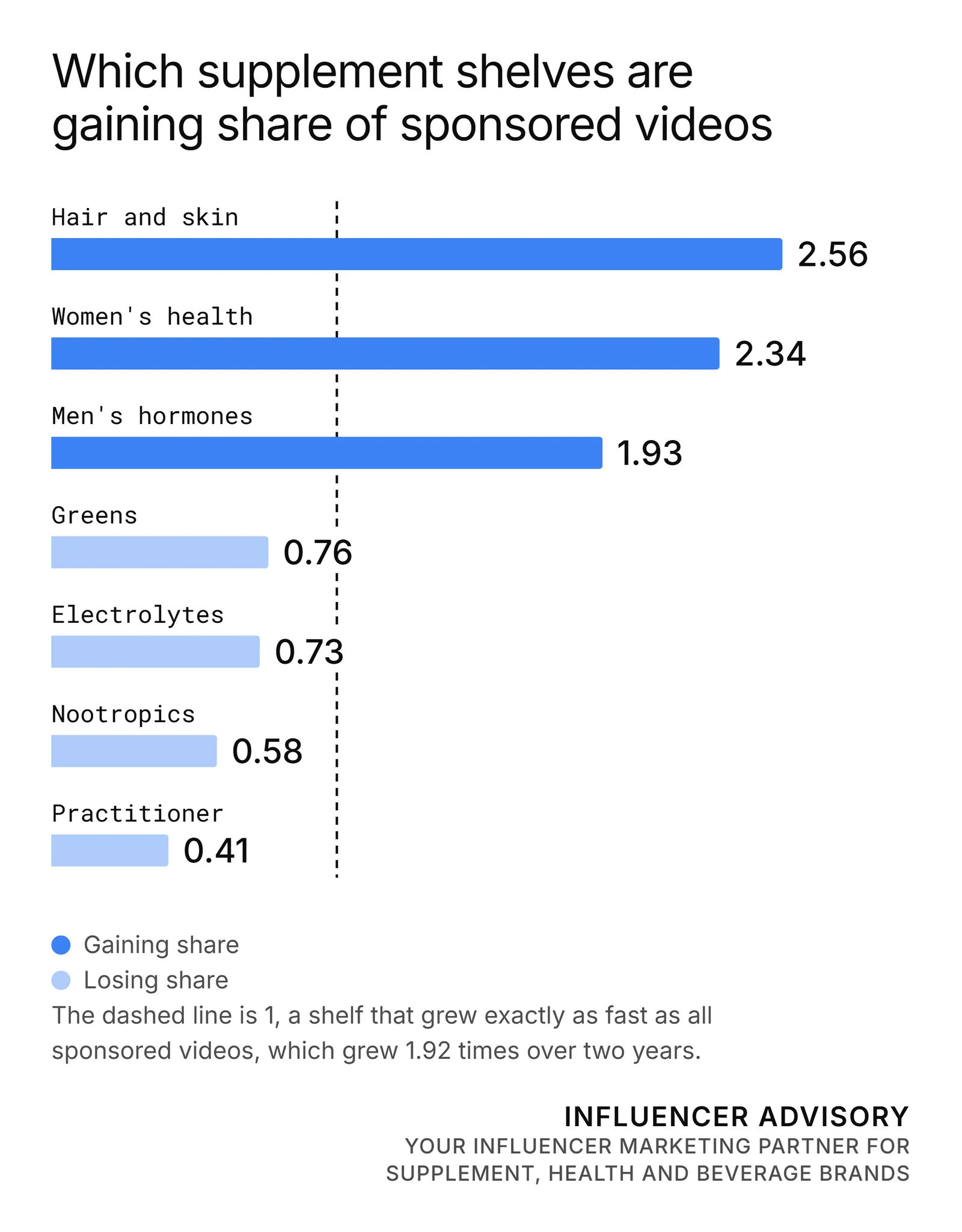
It depends on the shelf. Hair, skin, women's health and men's hormones are gaining ground, while greens, electrolytes, nootropics and practitioner brands are losing it.
Our whole table of sponsored videos grew 1.92 times over two years, so each shelf is measured against that, where 1 means it held its share. Hair and skin scored 2.56, women's health 2.34 and men's hormones 1.93, while greens scored 0.76, electrolytes 0.73, nootropics 0.58 and practitioner brands 0.41.
Whichever shelf you sit on, some audiences on it have nobody reaching them.
What audience is undersaturated?
We used to be professional only, so just working with healthcare professionals. ... the professionals don't really like us working with influencers in commercial approach because it makes them feel they lose their exclusive position. a supplement brand, on a call, June 2026
So our target audience is like 35, 40 plus, around perimenopausal phase. ... basically difficulty is finding influencers that are old enough. the same supplement brand, same call
Across 4,421 videos from a clinical supplement brand, a greens powder brand and a multivitamin brand, 6 mention menopause, and we hold no recorded sponsorship at all on the practitioner supplement shelf.
Once you know where the open audiences are, the next choice is whether to run the program yourself or hire someone.
Who runs it
Should we build this in house instead of hiring anyone?
any really big creator... they're reluctant to switch over because they want to do it in house. a sales software company, on a call
it could range from 15 to 25 people in-house, and we've never tapped into an agency whatsoever. the co-founder of a greens and energy drink brand
we're planning to keep our efforts in-house. a supplement brand, written
We don't give a budget to any agencies, we just have current onboardings with them, and if we like something, we work with them. a mattress brand, on a call, June 2026, on the middle option
we have the influencer program, which is like my main focus now, and what takes like, 80 to 90% of my time, like outreaching, talking to influencers, doing follow ups, closing agreements and things like that. a shipping software company, on a call, May 2026, on what running it in house takes
Running it in house does not take a big company, and the brands with the smallest teams run the biggest programs.
We are a small team. Are we too small to run this?
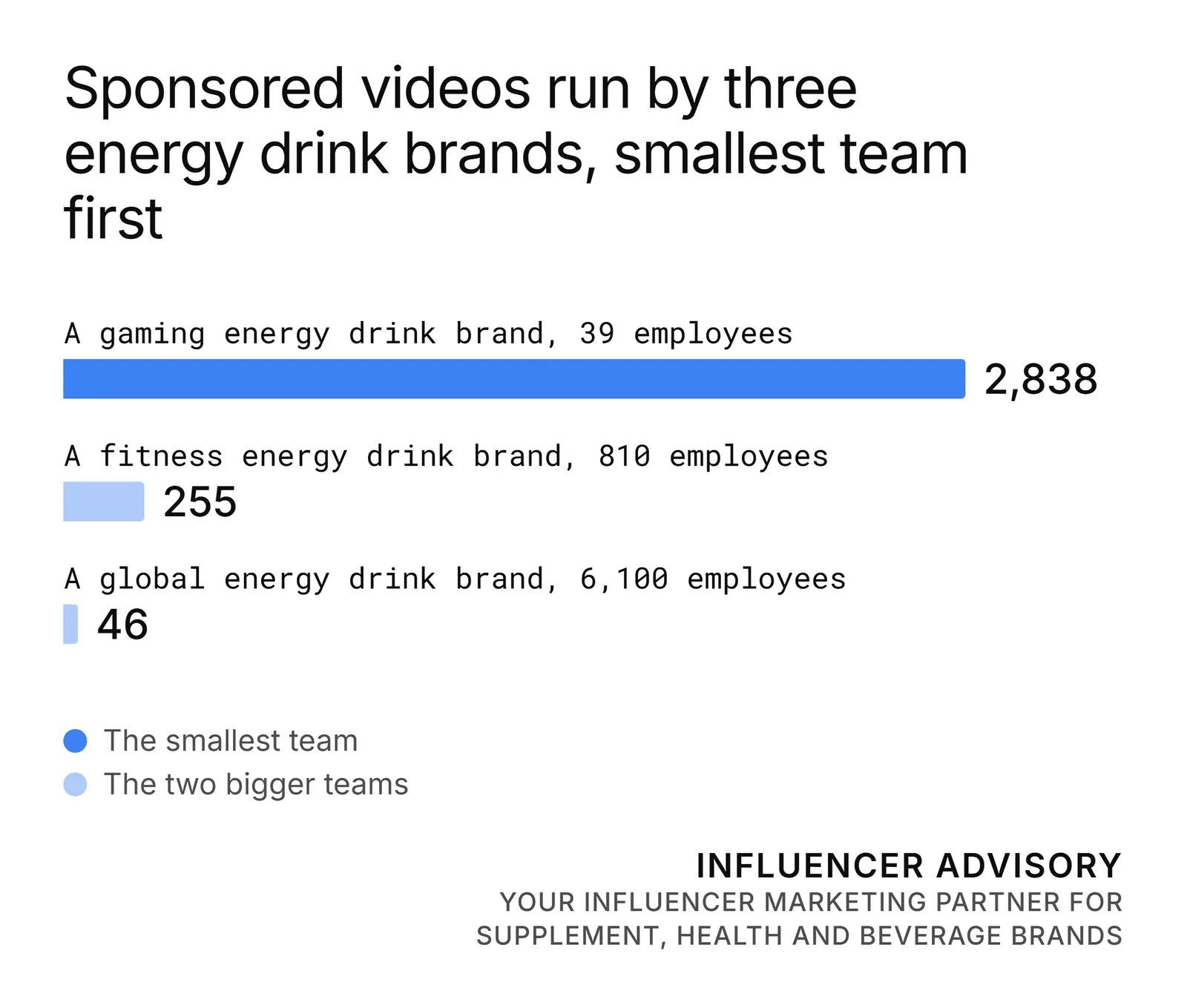
No. The smallest teams on this shelf run the biggest programs, so this is a choice a company makes rather than a budget it needs.
In our own table, a gaming energy drink brand with 39 employees ran 2,838 sponsored videos, while a global energy drink brand with 6,100 employees ran 46, and a fitness energy drink brand with 810 employees ran 255.
Whoever runs it, the first job is picking creators, and follower count says less than it looks.
Picking creators
Does follower count predict anything?
No. A pre-workout brand paid a creator with 670,000 followers $1,000 and got about 50 sales, while a creator with less than 10,000 followers, paid only per sale, sold just as many.
I don't think somebody below 100,000 I would be paying two and a half thousand for. a footwear brand, on a call
We paid her like $1,000 to do a post for us, and she got us like 50 sales, and we were like, ah man, she just barely paid for herself. the CEO of a pre-workout brand, about a creator with 670,000 followers
a micro influencer came into our office and was like, well, I'll do that, I won't even charge, just pay me for how many I sell, she posted and she had less than 10,000 followers and she did just as many sales as the big influencers. the CEO of a pre-workout brand
one of our top affiliates only has 7000 followers, so going off follower count is not really going to be a great measure of success. a beauty brand, on a call, January 2026
Our top affiliates are making over 10,000 a month. the same beauty brand, same call
In our own table, 56% of wellness deals go to channels between 100,000 and 1,000,000 subscribers, and the band under 25,000 is the least efficient on views per subscriber, not the underpriced one.
So brands that screen creators use other numbers instead.
What does a brand actually screen a creator on?
Not follower count. One brand gave us its rules, and audience size is not one of them.
the ratio between the views, the average views, and the subscriber has to be like as minimum one per four. a wellness device brand, on a call, July 2026
the at least 40% of the audience has to be from the United States. the same wellness device brand, same call
we definitely need an engagement rate from this influencer that is, like, certainly over 10% and then to run a dark ad with them. a wine brand, on a call, May 2026
Brands that counted the results also wrote down which creators did not pay back.
Which creators turn out to be a waste of money?
The ones that look close to your audience and are not. A brand that measured it wrote the list down for us.
Channels focused on tech products (e.g., reviews of phones or gadgets), travel, pop culture, or history tend to underperform for us a news app, written, May 2026
I have checked his performance, so he has generated only seven sales, only seven conversions over three Instagram Reels. So that's horrible. a wellness device brand, on a call, July 2026, on a longevity creator
Once you know who to book, the good ones still turn down a cold ask.
Why do good creators ignore your outreach?
The ask came before the relationship.
Strong creators reject cold outreach outright, the relationship has to precede the ask. the community marketing manager at a drinks brand
I started working with [an activewear brand] through [a run club]. I showed up to their events for coaching, since I also coach on the side, and that's how the relationship began. the community marketing manager at a drinks brand, on how her own biggest partnership started
these people can be hard to reach and also hard to convince that our brand is something that's right [for them]. a wine brand, on a call, May 2026
I outreach to 200 people to connect with, like, 30 or 40 of them, and then, like, for those 40, like, we're gonna close like 10 a shipping software company, on a call, May 2026, on its own outreach
Before paying anyone, some brands try sending free product in exchange for content.
What it costs
Does sending free product for content work?
Usually not on its own. One brand reached out to 1200 creators, heard back from 150, and kept three to five.
We did, like a seeding campaign as well for exchange for the content, but they also didn't work. an algae supplement brand, on a call, February 2026
we got like 150 responses that they were interested. And then it got, yeah, out of those, we didn't receive them, like, maybe, like 10 we could actually work with and out of those, maybe, like only three to five that are ongoing the same brand, same call
how we can measure the result of seeding? I don't know. Do you have any benchmark of percentage? the same brand, same call
Free product rarely works on its own, so the talk turns to price, and brands told us theirs.
What CPM do brands actually say they pay?
Fifteen to forty dollars per thousand views.
Yes, I checked the list of influencers, for youtube onboardings we usually land at CPM around 40 euro, so the prices proposed by you are too high for us. a mattress brand, August 2026
From a pricing standpoint, our standard benchmark is generally around a $15-20 CPM, depending on the creator and overall fit. an accessories brand, July 2026
Five more gave us their number. A precious metals dealer likes to sit at $20 to $35. A news app agreed $40 to test one video on two channels. A wellness device brand pays $40 with a cap, counted for 45 days. A podcast network sells video ads at $30, and a gaming software company pays $2 for vertical video.
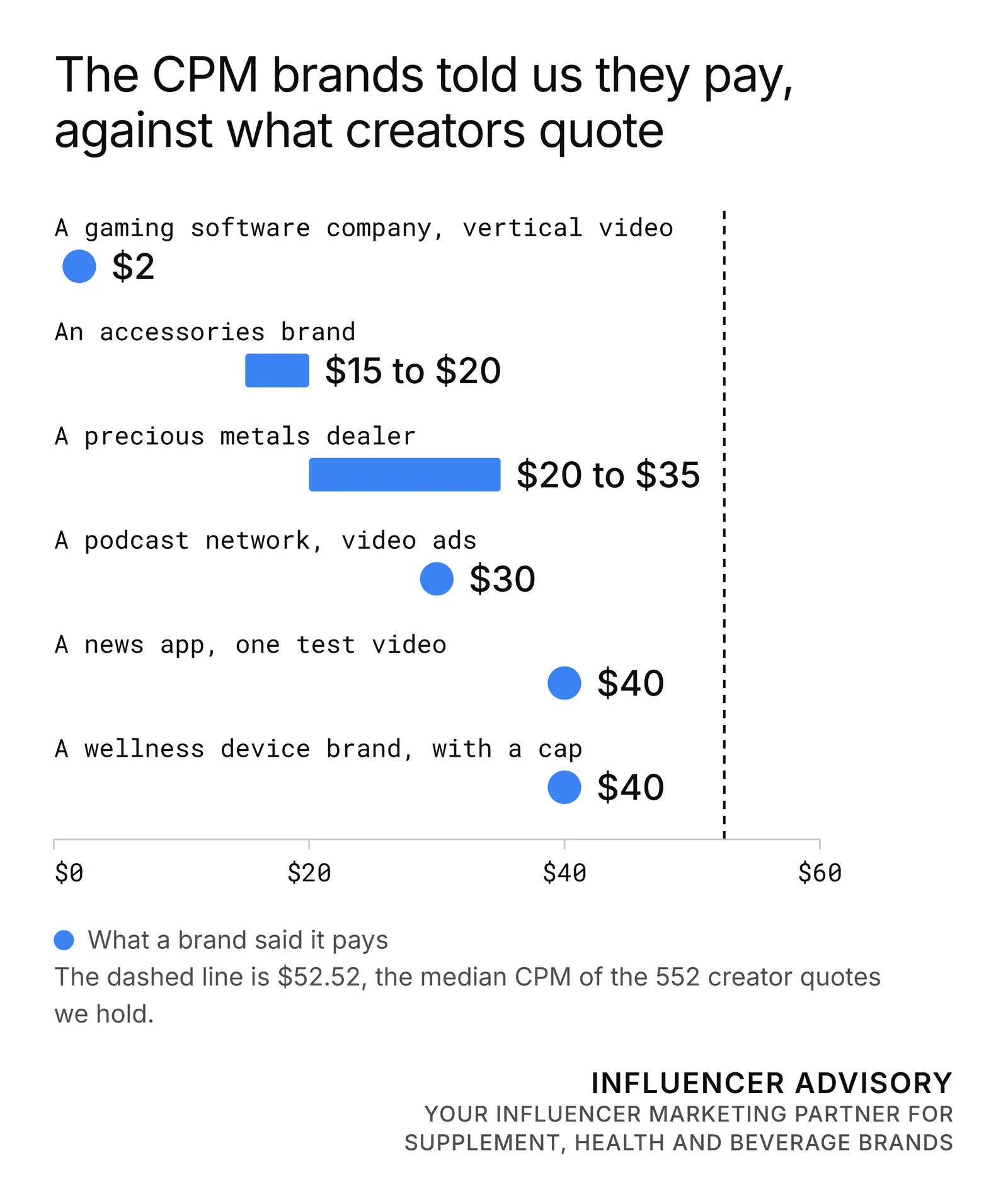
That is what brands pay, and it is rarely the first number a creator sends back.
Is a creator's rate card the price?
Typically not. Buyers who do this at volume say the first number comes back at two to four times what they end up paying, and the quickest way down is to strip the organic deliverables out of it.
you get these crazy high things, you'll get 40 grand, and it's like, hey, actually, and then like, you lowball, and like, you can get like a fourth of that or maybe half of it. a marketing podcast, on creator rate cards
whenever we're getting a rate back, we want to negotiate, the first thing we ask is any organic deliverables, like all right, get rid of all the organic stuff and let's knock it down 10K for that. a marketing podcast
We asked him to do another video, and he said it was an additional fee, so now he charges 2k for organic on Instagram. a telehealth brand, on a call
Cutting the rate card is one way down, and some brands say they get far better rates going to creators directly.
Can we get better rates going to creators directly?
Sometimes, because nobody agrees on the price. The same thing can cost 42 times more depending on who you ask.
I got very good rates from influencers I work with. You know, like, I have people who have, like, 900,000 followers. I paid them less than 1000 so, and they're, they're sellers. a footwear brand, on a call, January 2026
Across the 552 creator quotes we hold, one like is priced anywhere from $0.35 to $14.73, and the CPM runs from $14.23 to $418.49, with a median of $52.52.
With quotes that far apart, the safer anchor is a number you already hold.
How should I price a creator deal?
Work back from the CPM you already pay on Meta. One greens and energy drink brand builds its creator contracts off that number, and says its creator CPMs have stayed below $2 for months at a time.
going back to the contract, it's just all reverse engineered around CPM, right? So if you guys run Meta ads at home and you know what your CPM is, let's say it's $20 per thousand views. the co-founder of a greens and energy drink brand
if you scale it as robust and aggressively as we have, we've had CPMs that are below $2 for months at a time. the co-founder of a greens and energy drink brand
new active user is someone who prints at least five labels in a month. This is what we consider like a minimum new active user customer, and for those customers, we usually pay around like $500 on paid ads. So the CAC needs to be lower than that. a shipping software company, on a call, May 2026, on the number a creator has to beat
Set that against the $15 to $40 brands told us they pay: the number to beat is your own ad account, not the market.
That maths holds while you buy a placement, and it changes as soon as you ask the creator to make something new.
Production content price
Because you moved from buying a placement to buying a shoot, and the production cost gets priced into a higher CPM.
does it increase in price depending on where they post? or is it all included? a coffee equipment brand, on a call, May 2026, planning to run the videos as Meta ads
CPM start going up because we're talking about creating content, bespoke content, as production costs, that kind of thing. a wellness device brand, on a call, August 2026
normal standard, our CPM for integration is about 50 and for dedicated, dedicated video is about 100 a kitchen appliance brand, on a call, January 2026
A CPM is one way to price it, and a podcast read is priced per read instead.
What does a podcast integration cost and what comes back?
$3,000 a read, and about 30k dollars back off three of them, in the one case a brand tracked for us.
her integration on YouTube podcast was $3,000 for one integration for one midroll, we did three, and she has generated in total around 30k dollars, which is amazing, which is something more than expected. a wellness device brand, on a call, July 2026
Part of what a read earns can go to the creator as commission, and that changes what they charge up front.
What can a creator earn on affiliate on top of the fee?
Enough to bring the fee down. One brand pays 30 to 50 bucks a sale on top of a flat fee and gets a discount on the fee because of it.
we motivate them with with an extra CPA, which it could be from somewhere between 30 to 50 bucks per sale. In many cases, we get a significant discount because ... he has earned an additional $2,000 within two days frame. a wellness device brand, on a call, July 2026
Once the price is set, the next decisions go into the deal itself, starting with how long it runs.
What the deal should say
How long should the deal be?
Short to start. A marketing podcast says buyers moved off 6-month and 1-year deals to a short list of deliverables with 3 to 4 months of usage, then extend what works.
keep it not locked into a three month rate. Kind of a month to month. a subscription box brand, on a call
we were signing like 6-month deals, 1-year deals, big deals, and now we are saying we're going to do a very specific list of deliverables for paid with like 3 to 4 months of usage. a marketing podcast
shorter-term deals up front, with a smaller list of deliverables, validate the influencer in that funnel, then expand it to a longer-term deal. a marketing podcast
So over that 90 day pilot, we are going to select 10 on the first roster and then like we're going to do like one post per month with them or we will replace them if they're not going good on the first one. a shipping software company, on a call, June 2026
Clause 2 (Term Length): We would like to set the term to 12 months (rather than 24) a small nutrition app, written, redlining our contract
The shortest deal of all is free product, and brands have to say what free product does not include.
Is gifting the same as affiliate?
No, and one brand puts the line in writing. Most briefs leave it unclear, and then the gifted creators expect a cut too.
we only provide commission and links to creators who are officially part of our ambassador program. Gifting is separate and does not include commission or tracking links. a mushroom coffee brand, written
Are your creators interested in our ambassador program or are they specifically interested in paid opportunities? a cookware brand, written, July 2026
Commission and tracking links raise the next question, whether the creator gets a discount code at all.
Should you give creators a discount code?
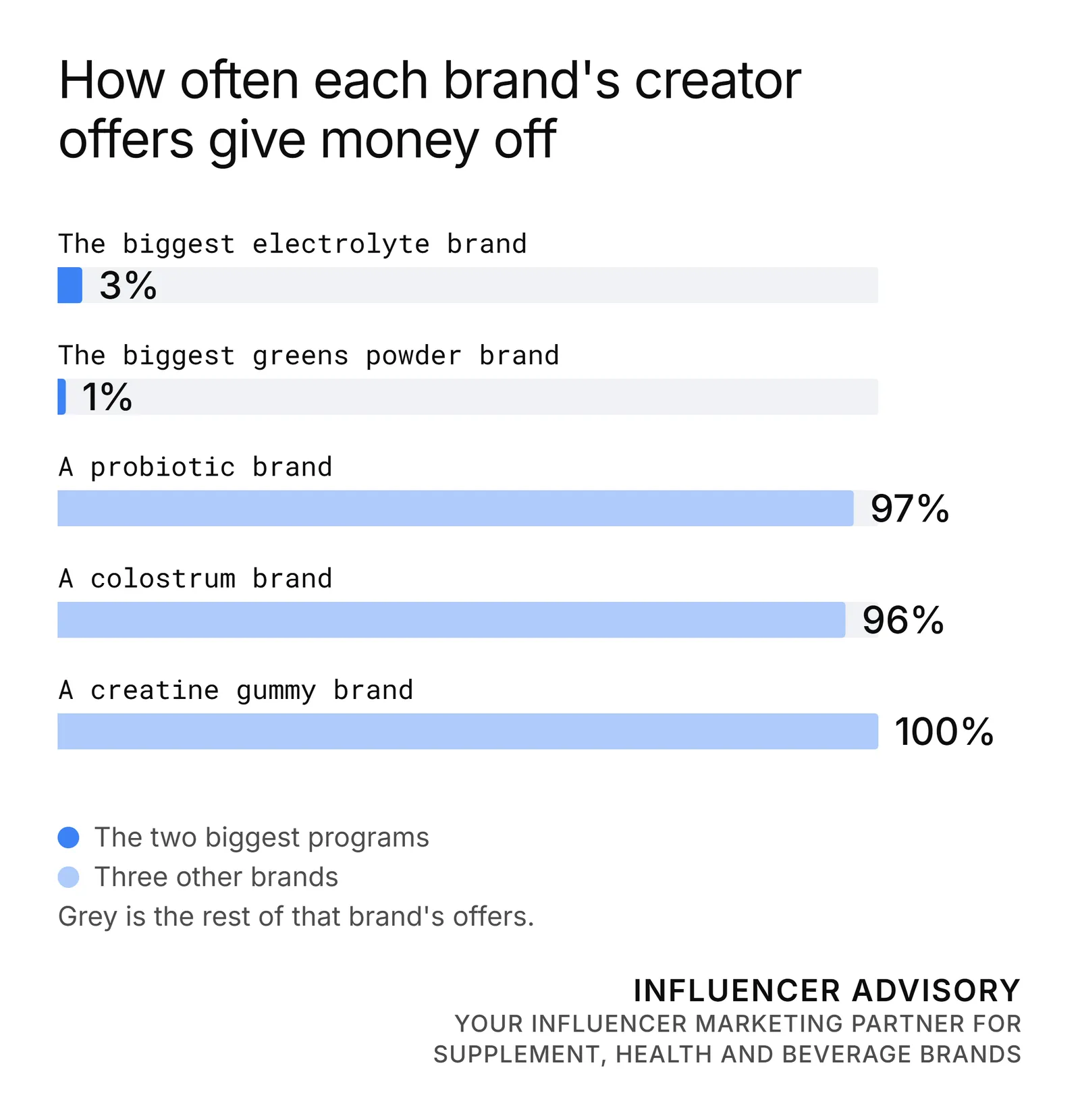
The biggest electrolyte brand and the biggest greens powder brand almost never do. They name a percentage off in 3% and 1% of their offers and give a free sample instead, while a probiotic, a colostrum and a creatine gummy brand put money off in 96% to 100% of theirs.
there was so much longevity to just a 15% discount, it lasted for two years like and we saw no need to change. the founder of an influencer agency, on the probiotic brand whose program she built
On the hydration shelf, the biggest electrolyte brand puts a free sample pack on 87% of its placements and a code on 4%, while every rival puts a code on 81% to 92% of theirs.
A code ties the creator to sales, and some brands want to pay on sales alone.
We paid four grand for one video and got nothing. Can we just go commission only?
You can ask. The problem is on the other side of the table, because brands want it and creators with agents almost never take it.
commission based, a commission based type thing, because for investing four grand into one video, we don't get a single sale. a telehealth brand, on a call, April 2026
it's really hard to find influencers that don't want, like, flat fee or an upfront payment, especially when they have an agency working with them. a shipping software company, on a call, May 2026
We are interested in influencer programs as long as the fees are outcome, revenue share based. a CBD brand, written
The second part is we also extend the affiliate link to the influencers, so they receive $75 for each person that comes through their link and print the label. a shipping software company, on a call, May 2026, on paying per signup as well as a fee
Commission is one thing a brand can buy on top of the video, and brands named others.
What can you buy besides the video?
Usage, a bonus for hitting a number, and a set window to run the content as ads.
We see great success through doing Instagram story series with 30 days paid usage run through their account. a vitamin brand, on a call, February 2026
Is the usage thing across paid ads, like we would probably want to own it for a significant [period of time]. a wine brand, on a call, May 2026
hey, if you bring me 20 users, I give you like, a bonus of $5,000 a shipping software company, on a call, May 2026
Exclusivity is another extra, and some brands do not know what it costs.
Booking exclusivity?
some brands are just kind of looking at it as like a walking billboard, usage, exclusivity, some brands aren't aware of how much those things can cost. a marketing agency, on usage and exclusivity
we are the only brand in the shipping business that works with influencers. ... gave up on like, doing exclusivity, because it doesn't make sense anymore for us. a shipping software company, on a call, May 2026
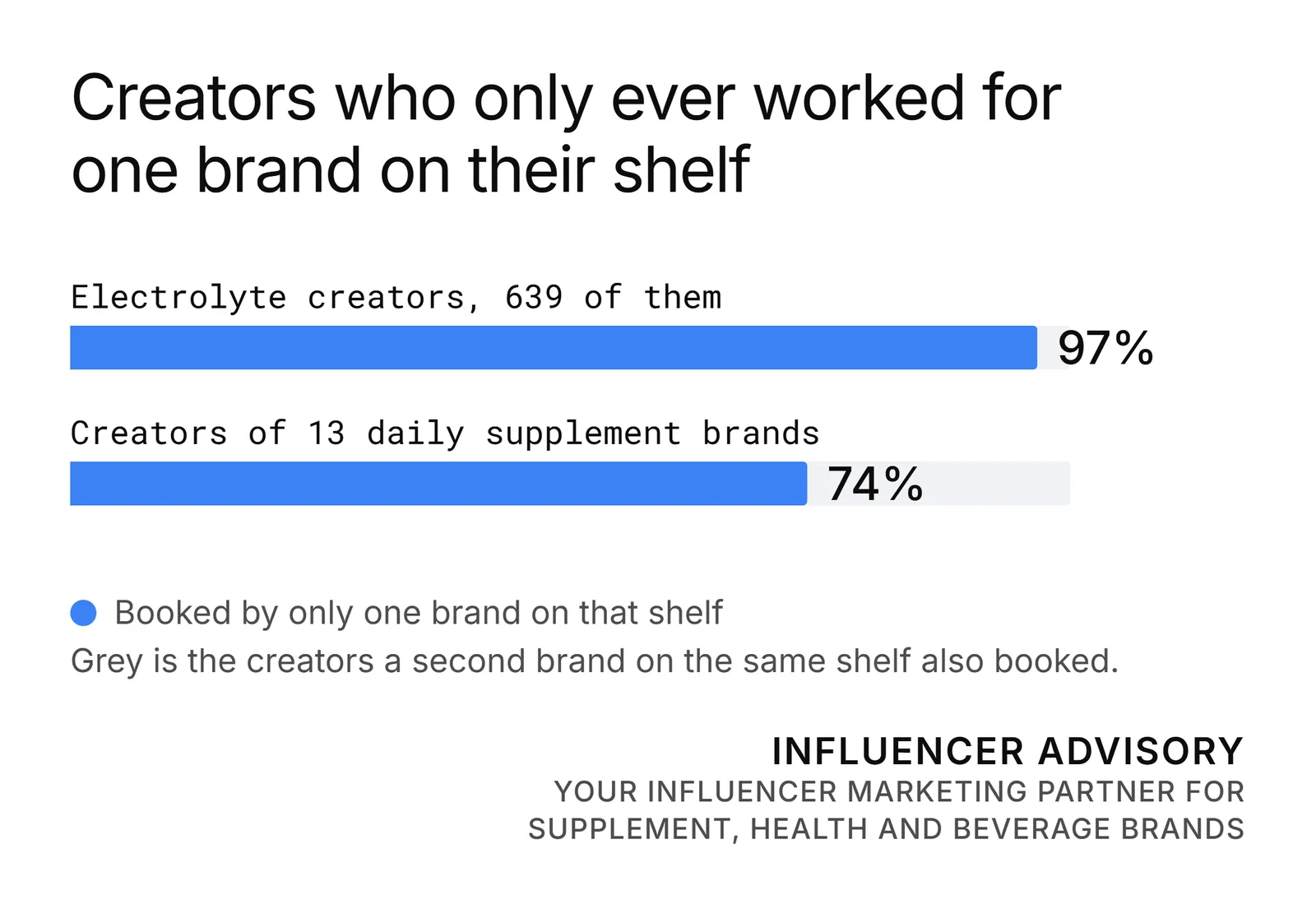
In our own table of sponsored videos, only 21 of 639 electrolyte creators were ever booked by a second electrolyte brand, and 1,778 of 2,411 creators across 13 daily supplement brands were paid by just one of them. Where we have seen exclusivity priced, it added $175 for three months, $300 more for six and $550 more for a year.
Our strategy make the creator like your brand
Exclusivity protects you from a rival, and the next thing brands ask for is a guarantee.
Can you get a guarantee?
Sometimes. One podcast network writes it into the deal: at least 250,000 impressions within 30 days, or a free make good episode or a smaller invoice.
We'll guarantee 250,000 impressions per spot. ... we guarantee that combines between the podcast and YouTube, that within 30 days you'll get at least 250,000 impressions. a podcast network, on a call, May 2026
If you don't, then what we do is we'll either provide a make good episode for you, or we would lower the amount, you know, if it misses by 100,000 then we would figure out the CPM and not invoice you for that. a podcast network, on a call, May 2026
A guarantee covers impressions, so brands also ask what happens when a campaign misses its goal.
What happens if it misses the goal, do you refund us?
Brands ask this constantly. Sellers offer a make good, meaning a free extra episode or a smaller invoice, not money back.
there can be a problem where we say, hey, we didn't reach the goal and then you're going to refund us. a shipping software company, on a call, June 2026, putting the question
we'll either provide a make good episode for you, or we would lower the amount, if it misses by 100,000 then we would figure out the CPM and not invoice you for that. a podcast network, on a call, May 2026, answering it
With no money back on offer, the safer start is a few creators rather than ten.
Running it
Can we start with a few creators instead of ten?
Yes, and brands ask for it in almost these words. The ones starting small still set a monthly budget to grow from.
I'm happy to give like, a few a try, like, the ones that I've sent you, but I don't necessarily need 10. Like, I think that's just a very high number. a footwear brand, on a call, January 2026
So we can basically trial it and if we like the influencers, we go ahead with some, if we don't we don't. a vitamin brand, on a call, February 2026
I think to start off the budget here is going to be somewhere between six to 10 per month. a cannabis brand, on a call, June 2026
However many creators you start with, on this shelf the paid read sits well into the video.
Where in the video does the ad actually go?
Well into it. The median sponsor read we checked starts 6 minutes 20 in.
107 of the 128 sponsor reads we verified start at 180 seconds or later, so the opening of a video is not what a brand on this shelf is buying.
A read that far in takes time to pay back, and brands tend to judge it too early.
Proving it worked
How long before we judge whether it worked?
Months, not weeks. A software company told us it sees no return for 80 to 90 days after a signup.
even though we are paying out on the signups, we don't see that return anywhere from 90 to 80 days after initial sign up a software company, on a call, May 2026
And, and what percentage of brands come back to you guys and then work with more and more and more influencers? ... Is it normally just a one off? a telehealth brand, on a call, June 2026
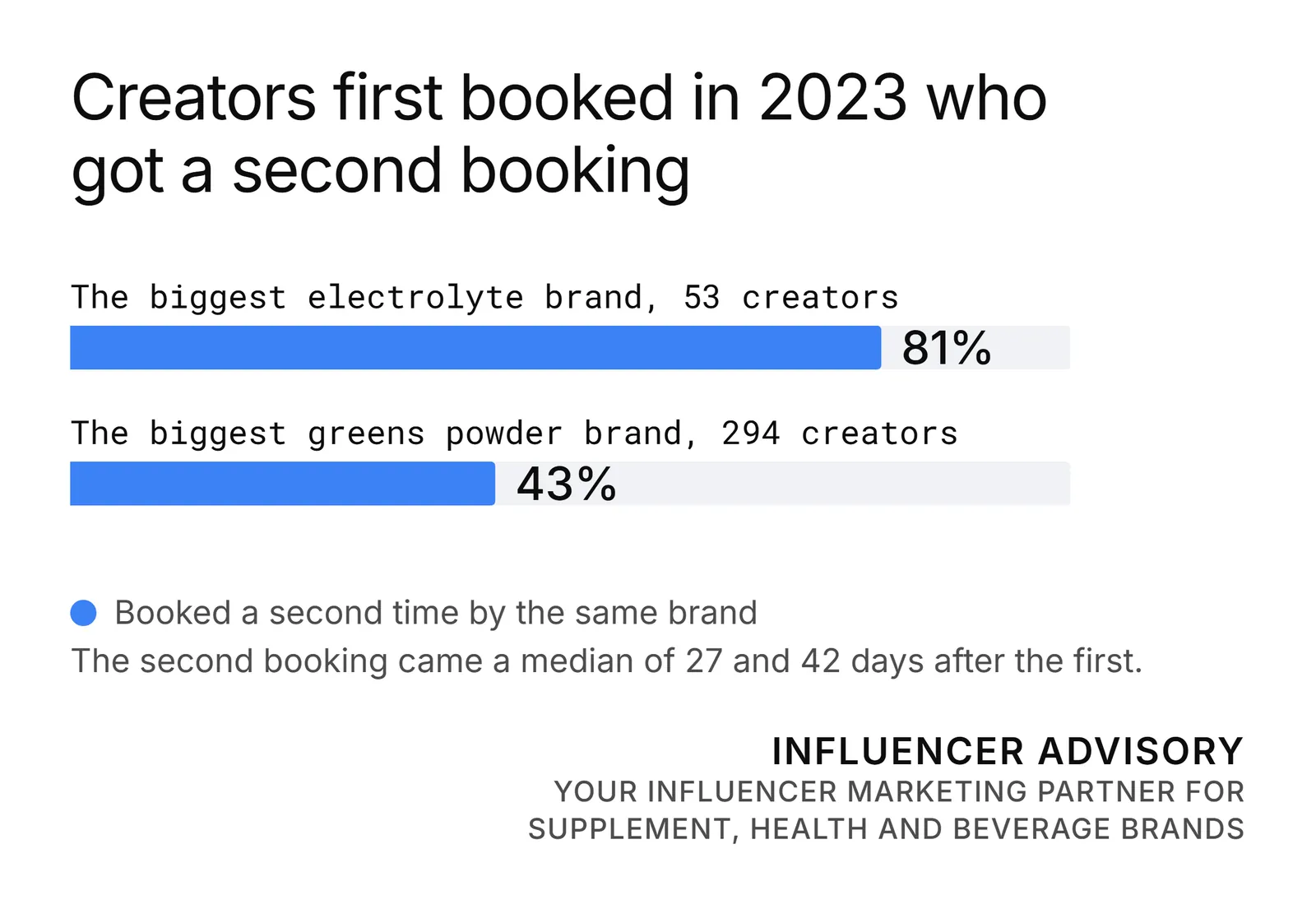
The brands that keep going book the same creators again. Of the creators the biggest electrolyte brand first booked in 2023, 43 of 53 got a second booking, and the biggest greens powder brand re-booked 125 of 294, a median of 27 and 42 days after the first.
Even with the right creators posting, crediting a sale to one of them is where brands get stuck.
Why can nobody attribute it?
The tracking is not the problem. At one supplement brand 80% of buyers came in on a referral from a therapist or a friend, so there is no channel to credit.
how do you attribute which influencers when generating a sale? from the coupon code? a telehealth brand, on a call, April 2026, weighing paying creators on commission
have the issue that 80% of the audience is a one time customer. a supplement brand, on a call, June 2026
the channel attribution is not always correct and then you see that 80% is coming because they got referred by a therapist or referred by a friend. the same supplement brand, same call
not even a percentage is attributed to us as a department, and we have very ambitious goals from direct sales. a wellness device brand, on a call, July 2026
When a sale cannot be credited to one creator, the brands doing this well judge each video as an ad instead.
Scaling what works
What do you do with the creator videos once you have them?
Put ad money behind the two that work and cut the rest. The brands doing this well treat a creator video as ad creative, not as a post.
usually what happens if you have 10 ads, say two of them do well, cut all of the others and then start to push spend behind them a telehealth brand, on a call, June 2026
it internally is kind of like it's a waste of money for us to put money behind eight of those ads. the same telehealth brand, on a call, June 2026
so we did 10 micro influencers, you know, and then what paid behind it, and then it worked out a coffee equipment brand, on a call, May 2026
Running the two that work as ads is the obvious move, and most brands barely do it.
We have the creator videos. Why is nobody running them as ads?
The ads belong to a different team, and that team books the revenue.
we pay extra for white listing usually when we book the Instagram reel, so the the cost goes to us, but then they run the white listing ads and the revenue goes to them to the media team. a wellness device brand, on a call, July 2026
Of the ads each brand has running, a pre-workout brand uses creator footage in 0% of 39, a non-alcoholic beer brand in 5.4% of 70, the biggest electrolyte brand in 11.9% of 37 and the biggest greens powder brand in 41.2% of 97.
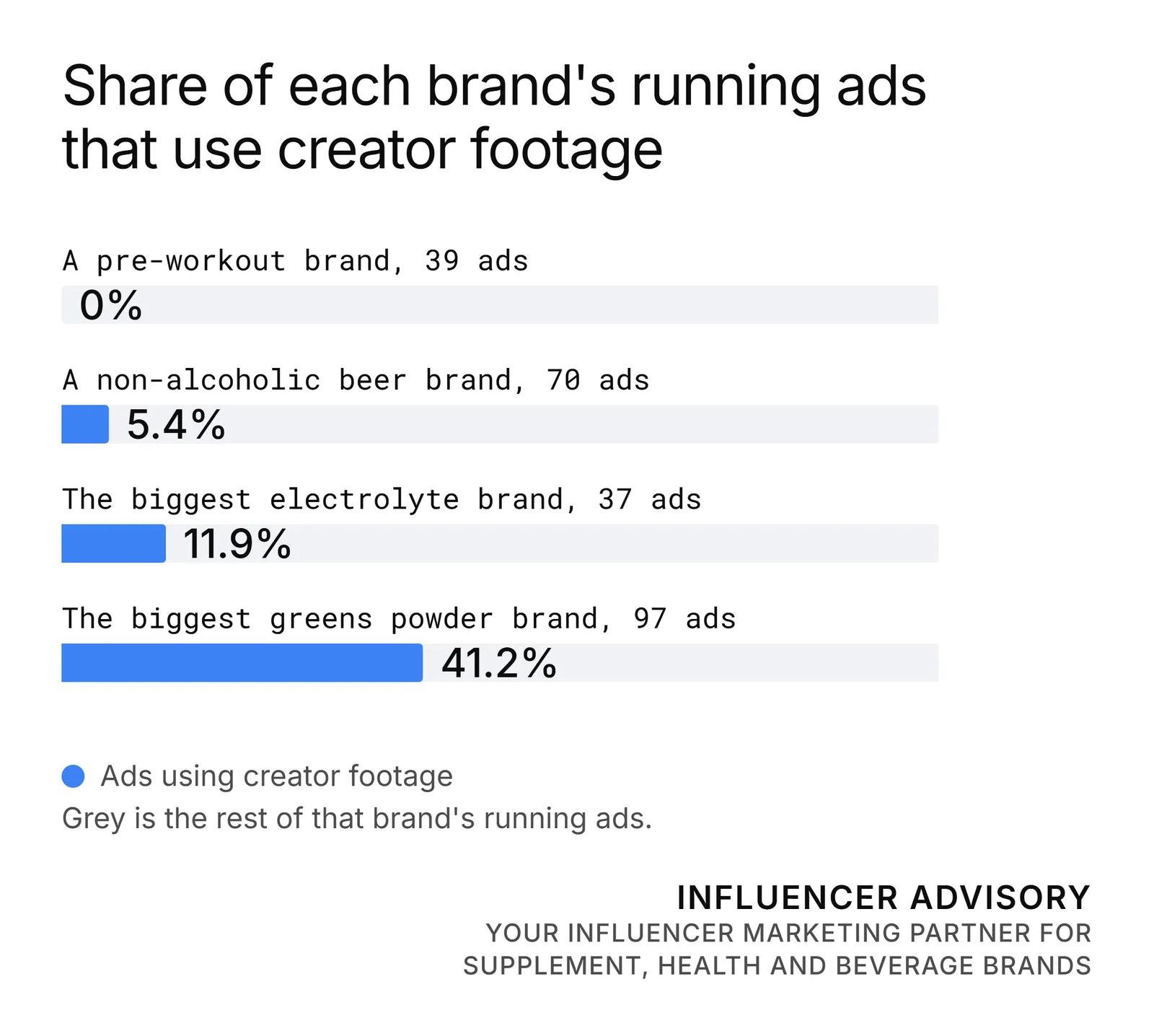
The cheapest win anyone described to us came from doing exactly that with $500 of content.
What is the cheapest thing that has ever worked?
Five hundred dollars of creator content, with media money behind it. The content was cheap, the ad money behind it was not, and that is where the return came from.
do you have some sort of introductory offer that isn't 10,000? That's a big commitment for me. a beauty brand, on a call
so that cost me $500 and uh we ran it as an ad and probably made 500,000 solid ROI. the founder and CEO of a hemp drink brand
Two of the biggest brands on this shelf went a step further and built an audience of their own before they had a product to sell.
Brands build their own media company
we made a Facebook page for [the brand] long before we ever had real product and we made a $1,500 funny video that got a couple million views, the page had like 880,000 followers. the founder of a canned water brand
we put together this free downloadable guide, how to make your own electrolyte mix, and within about six months we had a half million downloads of this thing, and we weren't sophisticated at all, we weren't using it as a lead magnet, this was years before [the brand] was even a thought. the co-founder of an electrolyte brand
Building your own audience can go as far as putting its people on the payroll instead of paying for posts.
Do you have to pay athletes at all?
A canned water brand pays none. It hires people who already have a scene around them and puts them on the payroll instead.
I don't pay an athlete. I don't pay any athletes. I don't sit around writing checks for sponsorships. Events need water, people need water. the head of brand and lifestyle marketing at a canned water brand
I have an adult film actress, I've got bass player of [a famous rock star], I've got a pro skateboarder, I've got a hip-hop tour manager, I've got lead singer of [a punk band]. the head of brand at a canned water brand, on who he hired instead of marketers
they get equity, they get dental, they get vision, they get health, they get a salary, but yet I still want them to go on tour. the head of brand at a canned water brand