
influencer whitelisting · usage rights
How Influencer Whitelisting Turns Organic Posts Into Paid Ads
Whitelisted creator content beats brand produced ads by 20 to 50 percent on almost every metric, and the brands that capture that value all do the same thing first, they buy the rights before the content exists. Four phases, six documented mistakes, and what Gymshark, Ridge Wallet, AG1, Graza and Liquid Death actually did.
Key takeaways
- Negotiate rights before the content exists. Once a post performs, the creator knows what it is worth, and fees, delays and refusals all go up.
- Usage rights and whitelisting are two different agreements. Paying for one does not get you the other, and finding that out mid campaign hands all the pricing power to the creator.
- Ridge Wallet contacted 18,700 creators, seeded 2,600, and generated over 1,000 tagged posts in four months at an $11.37 CPM, which is a pipeline of proven content to amplify.
- Gymshark's three tier ladder, seeding to ambassador to athlete, found top performers through natural posting behavior before any paid budget was committed.
- Five 2025 class actions over influencer disclosure sought between $25 million and $500 million, and FTC civil penalties run $51,744 to $53,088 per violation.
When executed correctly, influencer ads commonly outperform standard paid social by 20 to 50 percent on engagement metrics, Customer Acquisition Cost (CAC), Return on Ad Spend (ROAS), and Cost Per Acquisition (CPA) [1] [3].
Brands that fail to negotiate whitelisting terms upfront, or run content past its licensed window, face lawsuits, Federal Trade Commission (FTC) penalties of up to $51,744 per violation, and irreparable damage to creator relationships [4] [5]. This guide provides a detailed, research backed flowchart for navigating the organic to paid pipeline.
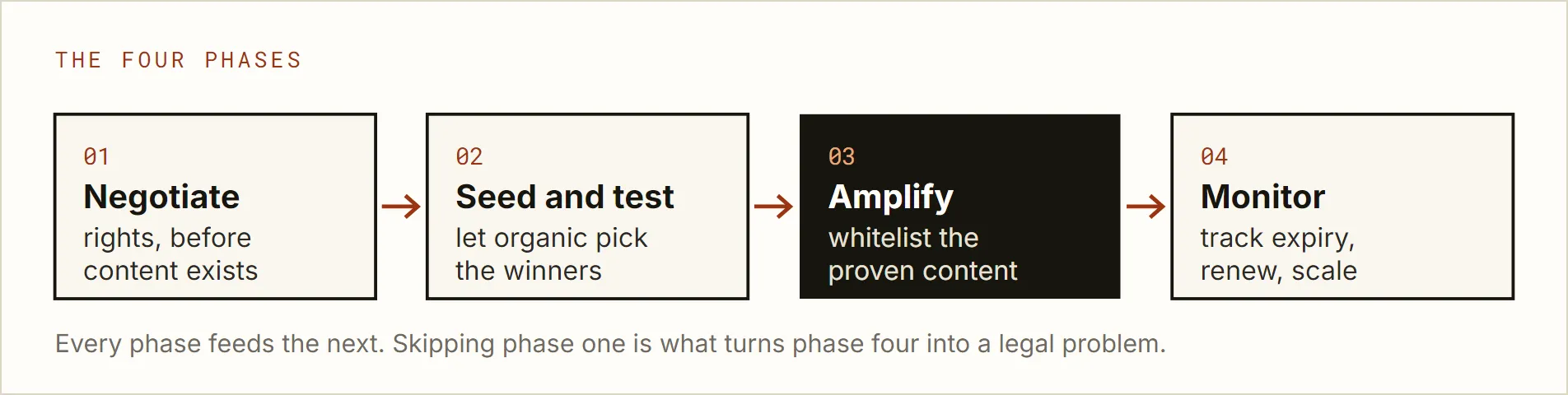
Phase 1, negotiate the rights before the content exists
The single most important principle in paid amplification is this, negotiate usage rights before the content is created, not after it performs well. When a brand discovers high performing organic content and then attempts to secure paid usage rights, the creator knows the content has value, resulting in higher fees, delays of days or weeks, and in some cases, the creator declining entirely [1].
Key definitions to align before negotiation
Before discussing pricing, both parties must agree on precise terminology. These terms are not interchangeable and must never be negotiated as a single line item [6]:
| Term | Definition | Typical cost impact |
|---|---|---|
| Usage rights | Permission to reuse creator content outside the original post on the creator's channel (brand social, website, email, retail) | 20 to 50% of base content fee |
| Whitelisting | Brand runs paid ads through the creator's handle using platform ad permissions | $150 to $2,000/month depending on tier [3] |
| Paid usage | Any use of the content in paid media, whether through the brand handle or creator handle | Separate line item, 5 to 20% of ad spend [7] |
| Exclusivity | Restriction preventing the creator from working with competitors for a defined period | 25 to 50% premium on base rate [3] |
| Dark posting | Running ads from the creator's handle that never appear on their organic feed | Included in whitelisting access |
If you are pricing a full buyout rather than a window, our breakdown of what a creator license buyout actually costs walks through the same line items in more detail.
The rights ladder approach
Rather than requesting "all rights" (which creators increasingly reject as a trust killer), brands should offer a tiered menu of options in their initial outreach [6]:
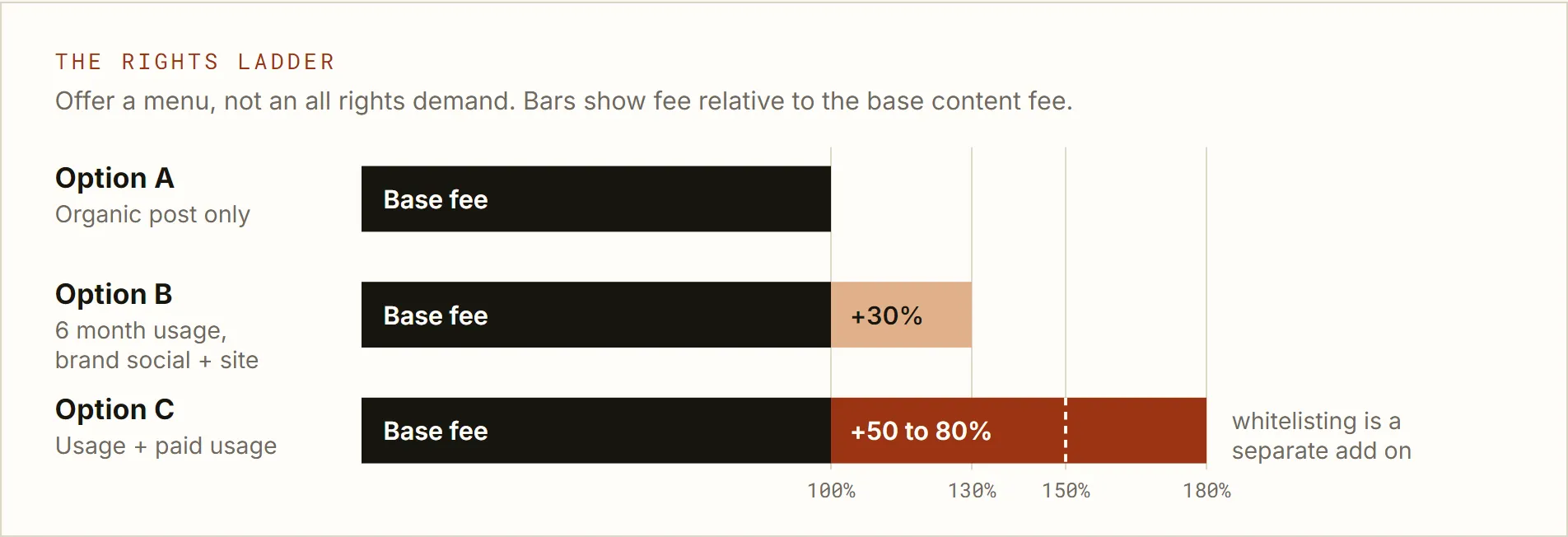
Option A, content creation and organic posting only (base fee).
Option B, six month usage rights for brand organic social plus website (base fee + 30%).
Option C, six month usage rights plus paid usage on brand handle, with a separate whitelisting add on if the brand decides to run ads through the creator handle (base fee + 50 to 80%).
This approach keeps the initial commitment reasonable, preserves upside for the creator, and prevents the brand from overpaying for content that might not scale [6].
What the agreement must spell out
According to Odin Law and Media, a firm specializing in creator economy law, influencer agreements must explicitly address the following to avoid disputes [8]:
Nature of access. Which accounts can be accessed and under what circumstances? Does the creator retain the right to revoke access in the event of abuse?
Modification rights. Can the brand re cut creator content, or only boost the original post? What approval rights does the creator have?
Length of whitelisting rights. The whitelisting window should not automatically match the campaign term.
Comment management. Can the brand comment on behalf of the creator? What approval process exists?
Security obligations. The brand must use reasonable efforts to keep the creator's account information secure.
Liability and indemnification. If the brand posts content that harms the creator or a third party, what are the consequences?
This is the part most brands get wrong, and it is the part we handle for you. We negotiate the rights, the whitelisting window and the edit permissions into the first contract, before anyone knows which post is going to take off, so you never end up buying access at the price of a proven winner.
Phase 2, organic seeding, content creation, and performance testing
The goal is to generate authentic content at scale and let organic performance identify the winners worth amplifying.
The high volume seeding model
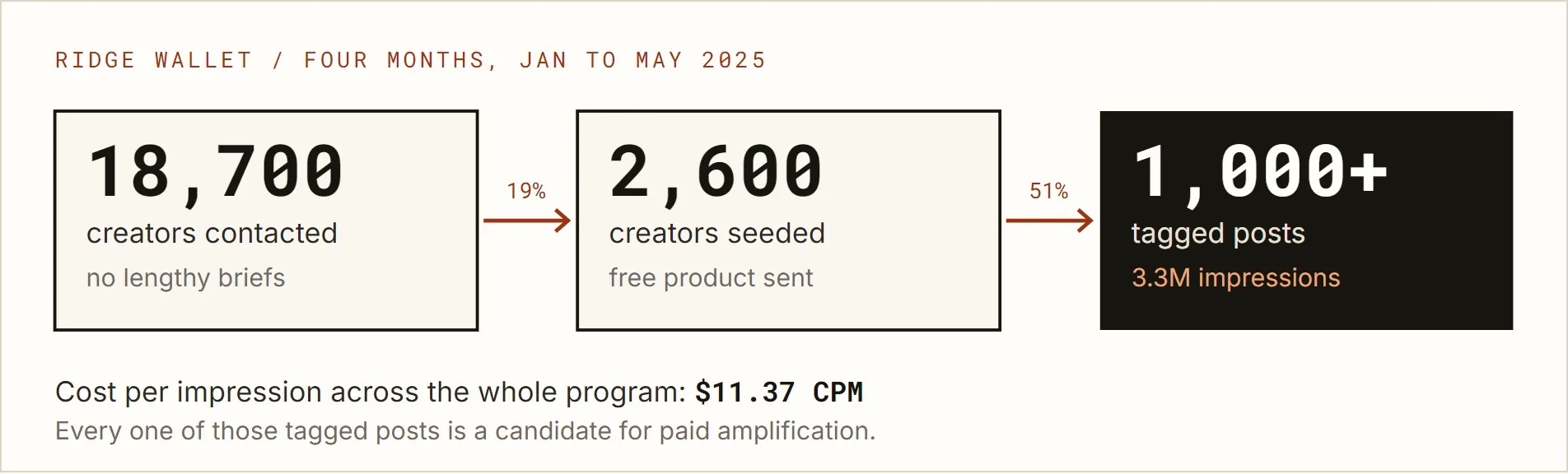
Ridge Wallet partnered with Aligned Growth Management to build a creator seeding program from the ground up. Their strategy prioritized high volume, low friction outreach with no lengthy briefs or overly curated campaigns. In just four months (January to May 2025), the program delivered [9]:
| Metric | Result |
|---|---|
| Creators contacted | 18,700 |
| Creators seeded | 2,600 |
| Total impressions | 3.3 million |
| Cost per impression (CPM) | $11.37 |
| Opt in rate | 19% |
| Posting rate (of seeded creators) | 51% |
| Tagged posts generated | 1,000+ |
They built a pipeline of high performing creators to nurture into ambassadors in a low risk fashion, creators whose content could be amplified with paid spend.
If you are still deciding whether to send product or pay upfront, our comparison of gifted product versus paid influencer deals covers when each one is the cheaper way in.
The three tier pipeline model
Case study, Gymshark. Gymshark built a £607 million revenue brand through a three tier pipeline [10]:
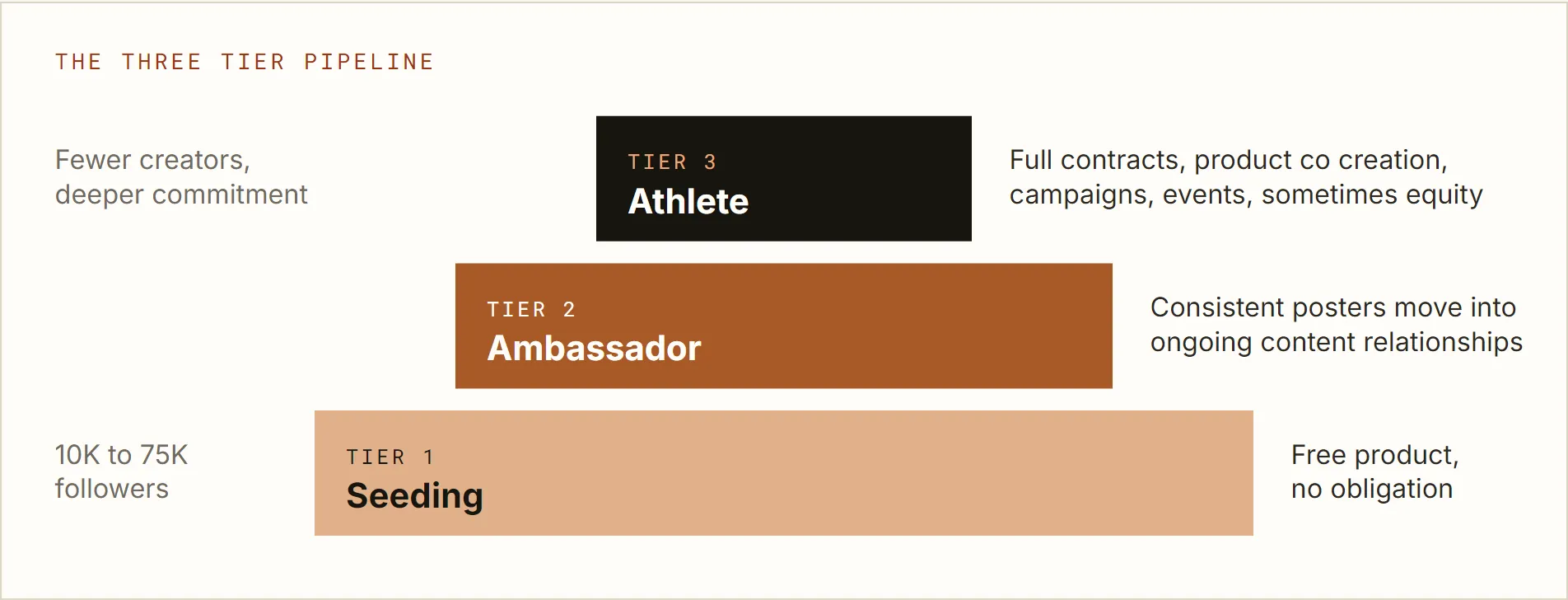
Tier 1, seeding. Free product sent to promising creators (typically 10K to 75K followers) with no formal posting obligation. This filters for authenticity.
Tier 2, ambassador. Creators who consistently post after receiving seeded product move into ongoing content relationships with regular posting expectations.
Tier 3, athlete. Full contractual partnerships with product co creation, campaign integration, event participation, and in some cases, equity stakes.
This progression model allowed Gymshark to identify top performers through natural posting behavior before committing paid amplification budgets. Their micro influencer focus (10K to 75K followers) delivered 6.6x Instagram ROI and 40% of initial sales [10].
Identifying content worth amplifying
Not all organic content deserves paid spend. Brands should evaluate content against the following criteria before activating whitelisting:
| Signal | What to look for |
|---|---|
| Engagement rate | Above creator's average, 4 to 9% is the sweet spot [10] |
| Comment quality | Purchase intent questions ("Where can I buy this?") vs. passive reactions |
| Save/share ratio | High saves indicate content people want to return to |
| View completion | For video, high completion rates signal compelling content |
| Organic reach velocity | Content that spreads quickly beyond the creator's core audience |
"Once we passed along an influencer's high organic ROAS video to our paid team and it got a 12x ROAS, I'm not even joking. It was wild. I still remember the paid team told us they'd never seen something like this." Kendall Dickieson, Head of Social and Influencer, Graza [11]
Phase 3, paid amplification execution
How to do it.
Meta (Facebook and Instagram)
Brands can leverage paid media on Meta in three ways [11]:
1. Run creator content from the brand page (dark post). The brand uses the creator's content as ad creative but runs it from their own account. This requires usage rights but not whitelisting access.
2. Run content from the creator's page (whitelisting). The influencer grants Business Manager access. The brand then runs ads directly from the creator's handle, reaching audiences far beyond the creator's organic followers. The creator must have a Business or Creator account linked to their Business Manager [11].
3. Partnership Ads (Branded Content tool). Both the brand and creator are tagged in the post. This is generally recommended as it allows brands to reach a wider audience while maintaining transparency [11].
TikTok (Spark Ads)
TikTok's Spark Ads enable brands to amplify existing organic TikTok content as ads directly from the creator's account. The creator grants access via a code, and the brand runs paid promotion behind it [11]. Key advantages include:
+25% click through rate (CTR) and +24% conversion rate (CVR) compared to standard in feed ads [3]
Maintains the original caption, sounds, and hashtags
Engagement metrics are attributed to the original post, boosting its overall performance
Viewers can engage with Spark Ads just like organic content
Whitelisting vs. boosting, a critical distinction
| Feature | Boosting | Whitelisting |
|---|---|---|
| Ad account control | Creator's | Brand's |
| Targeting options | Limited | Full |
| Dark post capability | No | Yes |
| Creative flexibility | Low | High |
| Optimization control | Minimal | Complete |
| A/B testing | Not possible | Full testing capability |
Performance benchmarks
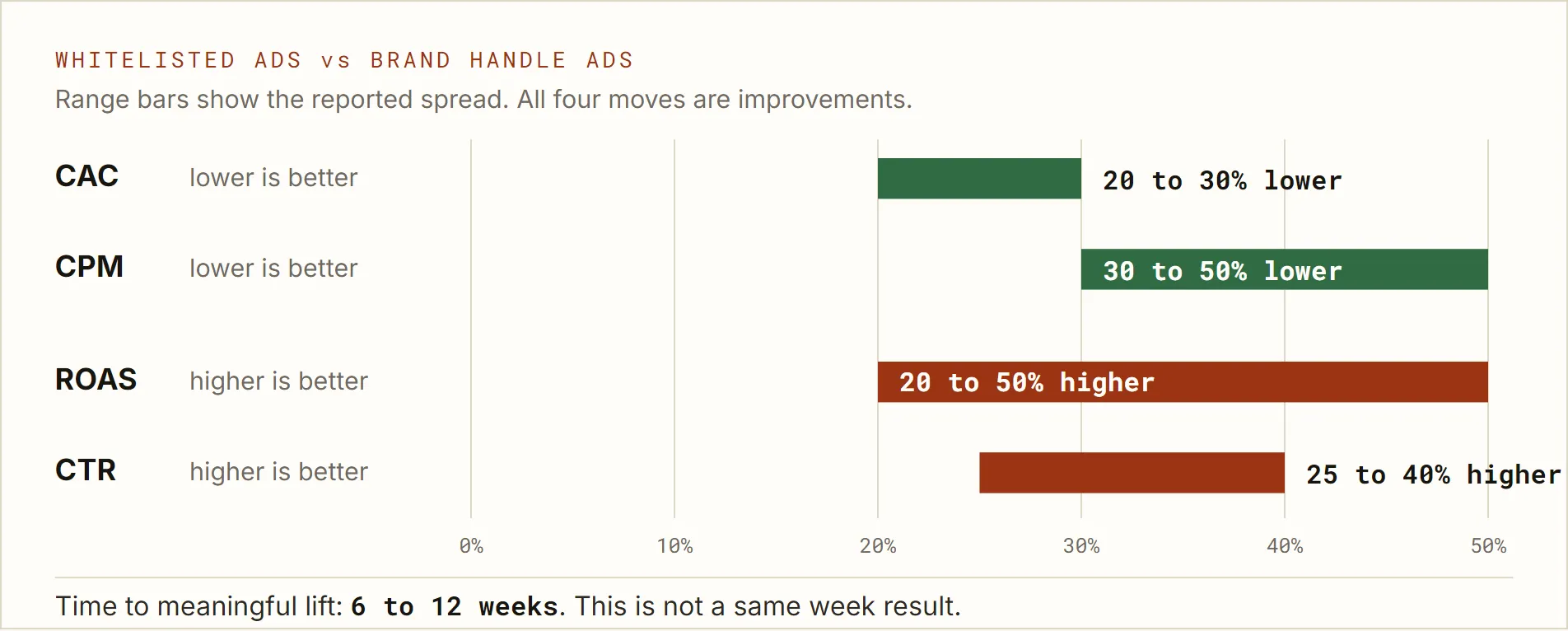
Based on aggregated industry data, brands can expect the following from whitelisted creator ads versus standard brand handle ads [1] [12]:
| Metric | Whitelisted ads performance vs. brand ads |
|---|---|
| CAC improvement | 20 to 30% lower |
| ROAS improvement | 20 to 50% higher |
| CPM | 30 to 50% lower |
| CTR | 25 to 40% higher |
| Time to meaningful lift | 6 to 12 weeks |
Case study, Top Growth Marketing direct to consumer (DTC) clients. A DTC beauty brand achieved a 170% revenue increase in six months through whitelisted creator ads with AI assisted vetting and Meta Partnership Ads. An apparel brand achieved a 3.11x ROAS from a single whitelisted creator. A nutrition brand (Cira Nutrition) achieved 1.78x ROAS improvement in month one of whitelisting [12].
Phase 4, monitoring, renewal, and scaling
As programs scale, tracking usage rights expiry becomes a critical operational function. Brands must maintain a centralized system with the following fields for each asset [6]:
Start date and end date of usage rights
Channels permitted (organic, paid, website, email, retail)
Paid usage status (active/inactive)
Whitelisting access status
Renewal option terms and deadlines
Creator approval requirements for modifications
"By the time a creator's representative notices their client's face running on paid placements six months after usage rights expired, multiple people have made reasonable seeming decisions in isolation that add up to a clear rights violation." TrueRights [13]
Performance based renewal models
Rather than committing to long fixed term licenses upfront, leading brands are adopting performance based usage pricing [13]:
Structure A, fixed license fee. One usage rights fee for defined channels and duration. Simplest for budgeting.
Structure B, base license plus renewal option. Pay for an initial window (e.g., 30 days), then renew monthly if the asset performs. Reduces overpaying for content that never scales.
Structure C, monthly usage fee tied to ad continuation. If ads keep running, the creator keeps earning. This aligns incentives and keeps pricing fair over time [6].
Documented mistakes, what has gone wrong
Mistake 1, running content past rights expiry
A beauty brand used an influencer's Instagram image in nationwide in store displays without permission. The original agreement only covered one photo and one video for social media, yet the brand pulled a different post and used it in retail. The result, a $40,000 legal demand followed by a lawsuit for misappropriation of likeness [14]. One mid tier influencer disclosed being paid over $20,000 just for a three year usage extension after the brand attempted to continue using content beyond the original term [14].
Mistake 2, AI manipulation without consent
In June 2026, New York based creator Francheska Pujols sued clothing brand Rainbow Shops for allegedly using AI to create images of poses she never struck, including one showing her straddling a barstool [15]. Her contract granted Rainbow the right to take and use photos "distorted in character or form, cropped or altered, without restriction as to changes or transformations." However, Pujols argues this did not authorize AI generated synthetic images [15].
In a separate case, creator Molly Tranchin sued an underwear company (Empowered By You) after it allegedly posted an AI altered video depicting her exposing her breasts, despite their agreement that she would have final approval of edits [15].
Creator Larisa Arnold discovered that a throat spray brand had altered her filmed ad to change her facial reactions and insert words she had never said using AI. The brand admitted to the modification and took the ads down, but told her that creators who do not want this to happen "should request a separate agreement spelling that out" [15].
Mistake 3, copyright infringement through influencer content
In October 2023, Sony Music Entertainment sued Ofra Cosmetics for copyright infringement, alleging unauthorized use of Sony recordings in over 300 social media videos [16]. The lawsuit targeted three categories of content, videos Ofra created directly with Sony music, videos created by influencers for Ofra (for cash, commissions, or free product), and organic influencer videos that Ofra reposted to its own pages [16].
Sony noted that other cosmetics companies (Estee Lauder, Cover Girl, Revlon, MAC, Shiseido) had all secured proper licensing deals for Sony recordings in their social media content [16]. The key takeaway, just because music is available on a social media platform does not mean it is authorized for use by brands or their influencers in commercial content [16].
Mistake 4, FTC disclosure failures at scale
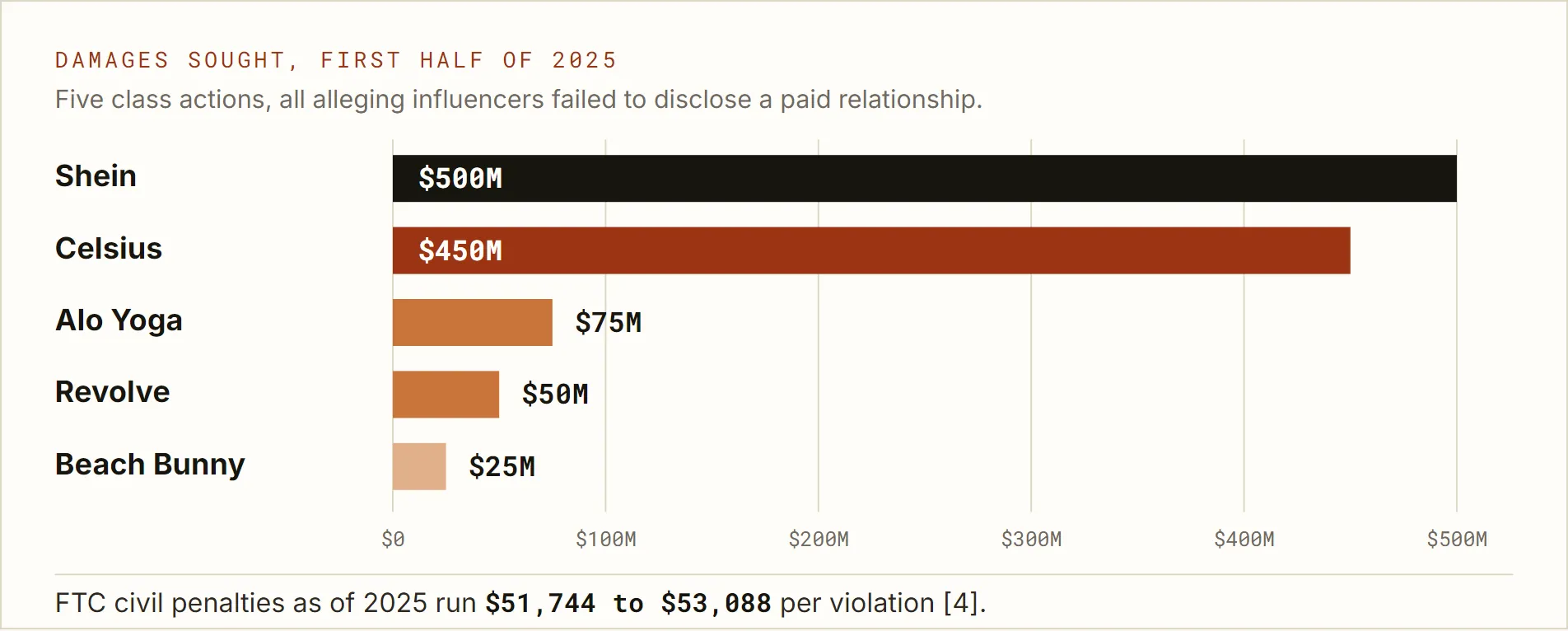
In the first half of 2025, a wave of class action lawsuits targeted major brands for inadequate influencer disclosure practices [5]:
| Case | Brand | Alleged violation | Damages sought |
|---|---|---|---|
| Dubreu v. Celsius Holdings | Celsius | Influencers promoted products without disclosing material connection | $450 million |
| Bengoechea v. Shein | Shein | Influencers omitted or buried disclosure language | $500 million |
| Negreanu v. Revolve Group | Revolve | Influencers used proper disclosures for other brands but omitted them for Revolve | $50 million |
| Sulici v. Alo Yoga | Alo Yoga | 14 influencers promoted products without disclosing paid relationships | $75 million |
| Alin Pop v. Beach Bunny | Beach Bunny | Influencers failed to clearly disclose paid partnerships | $25 million |
All cases allege that undisclosed influencer partnerships constitute deceptive business practices that allow companies to charge premium pricing [5]. FTC civil penalties run between $51,744 and $53,088 per violation as of 2025 [4].
That risk grows with every creator you add, because one missing disclosure on one whitelisted ad is enough to start a claim. Our 2026 FTC playbook for influencer marketing covers the disclosure language that holds up, and it is the same checklist we run across every creator on a program we manage, before a single ad goes live.
Mistake 5, assuming usage rights covers whitelisting
Usage rights and whitelisting are separate agreements. Usage rights let a brand repost content on their own channels, whitelisting grants paid ad account access to run spend through the creator's profile directly [3]. Brands that pay for one do not automatically get the other. Discovering this mid campaign means a second negotiation under deadline pressure, at which point the creator holds all the pricing power [3].
Mistake 6, leaving whitelisting out of the initial brief
When whitelisting is not discussed in the initial brief, brands must renegotiate once they already need it. At that point, the creator knows how much the brand wants access, shifting all pricing power to the creator [3]. Building whitelisting terms into the first contract locks in a rate before the creator knows how valuable the content will become.
Success stories, what has gone right
Athletic Greens (AG1), whitelisting as a growth engine
Athletic Greens, the $1.2 billion supplement brand, built its entire growth strategy around influencer marketing before raising outside funding [17]. Their approach to whitelisting is particularly instructive:
AG1 runs whitelisted ads from multiple influencer accounts simultaneously, reaching audiences far beyond each creator's organic following [17].
They only partner with creators who are genuine customers of the product, ensuring authenticity even when content runs as paid ads [17].
Each creator receives a custom themed landing page (e.g., athleticgreens.com/tim for Tim Ferriss listeners), creating a seamless experience from whitelisted ad to conversion [17].
The pitch to creators frames whitelisting as mutual benefit, the brand spends marketing dollars growing the creator's audience while the creator produces authentic content [17].
Graza, 12x ROAS from organic to paid handoff
Graza, the olive oil brand, achieved extraordinary results by systematically passing high performing organic influencer content to their paid team. One influencer's video that performed well organically achieved a 12x ROAS when run as a paid ad, a result the paid team described as unprecedented [11]. The brand won 7x ROAS using co branded landing pages that connected influencer content to direct conversion paths [18].
Liquid Death, 30 billion impressions on $2 million spend
Liquid Death's approach demonstrates the power of entertainment first content amplification [19]:
A 5 person in house creative team produces content rapidly without layers of agency approvals.
Creators receive zero strict briefs, producing organic integration that resonates far better than scripted product placements.
The brand identifies "unpaid, unprompted, unbriefed" user generated content (UGC) posts featuring Liquid Death and reaches out to creators to secure usage rights for amplification [19].
By repurposing top performing organic content into paid ads, they achieved over 30 billion earned media impressions on less than $2 million in total production and talent spend [19].
DTC beauty brand, 170% revenue lift through whitelisting
A DTC beauty brand working with Top Growth Marketing achieved a 170% revenue increase in six months through a systematic whitelisting program [12]. The process involved AI assisted creator vetting, structured creative briefs tuned to each creator's voice, and Meta Partnership Ads management. The brand saw whitelisted ads outperform brand handle ads within 4 to 8 weeks, with meaningful ROAS lift emerging in weeks 6 to 12 as the agency tested 3 to 5 creator and creative combinations and scaled the winners [12].
The usage rights contract checklist
For brands preparing to negotiate paid amplification rights, the following checklist should be incorporated into every influencer agreement [6] [8]:
| Contract element | Details to specify |
|---|---|
| Content covered | Asset list, filenames, links, or deliverable IDs |
| License grant | Non exclusive usage rights granted to [Brand Name] |
| Channels permitted | Brand organic social, brand paid social, website, landing pages, email, SMS, retail, events |
| Duration | Start date, end date, renewal option terms |
| Territory | Countries or regions (do not buy global rights out of habit) |
| Paid usage terms | Paid allowed yes/no, if yes, platforms and ad accounts specified |
| Whitelisting terms | Allowed yes/no, duration, spend cap if applicable, access method |
| Edit permissions | Light edits allowed (cropping, captions), material edits require creator approval, AI usage explicitly addressed |
| Brand safety | Prohibited contexts (political, sensitive topics, competitor adjacency) |
| Exclusivity | Category, start and end dates, compensation for exclusivity |
| Attribution and disclosure | Required FTC disclosure language or platform tools |
| Compensation breakdown | Content creation fee, usage rights fee, whitelisting fee, renewal fee schedule |
| Termination | Circumstances for termination, repercussions, how creator pay and brand rights are affected |
| Security | Brand's duty to use reasonable efforts to keep creator accounts secure |
| Indemnification | Consequences if brand posts content that harms creator or third party |
Conclusion
The organic to paid influencer pipeline is not a simple "boost" button. It is a multi phase strategic process that requires upfront legal negotiation, systematic content testing, platform specific execution, and rigorous compliance monitoring. Brands that build usage rights and whitelisting terms into their initial contracts, use organic performance as a filter for paid spend, and maintain operational systems for tracking rights expiry will consistently outperform those that treat amplification as an afterthought.
The data is unambiguous, whitelisted creator content outperforms brand produced ads by 20 to 50% across every meaningful metric [1] [3] [12]. But the brands that capture this value are those that respect the creator relationship, compensate fairly for additional rights, and maintain the operational discipline to stay within their licensed scope.
If you want the pipeline run for you, that is what we do. We find and vet the creators, negotiate the usage rights and the whitelisting window into the first contract, keep every disclosure compliant, and track expiry dates so nothing runs a day past its license. If you are budgeting the whole program first, start with what influencer marketing actually costs, then book a quick call and we will map your version of it.
References
- HireInfluence. (2026, April 8). Influencer Paid Media Agency, How Amplification Actually Works.
- EMARKETER. (2025, April 9). Brands are dedicating more of their influencer marketing budgets to paid media.
- Launchpoint. (2026, June 9). What Is Influencer Whitelisting? How It Works for Brands in June 2026.
- Launchpoint. (2026, June 20). 2026 FTC Influencer Disclosure Rules.
- Morgan Lewis. (2025, June 16). Influencer Marketing Class Actions on the Rise, Common Themes and Key Takeaways.
- ViralFusion. (2026, February 24). Influencer Usage Rights in 2026, How to Price, Negotiate, and Avoid Costly Overuse.
- Impact.com. (n.d.). How much to charge for usage rights, influencer guide.
- Odin Law and Media. (2022, September 21). What are the risks of influencer whitelisting?
- Aligned Growth Management. (n.d.). Ridge Wallet, From Pocket Essential to Social Staple.
- Archive. (2026, June 30). Gymshark Influencer Marketing Strategy, Complete Breakdown.
- Superfiliate. (n.d.). Influencer Whitelisting and Paid Media, Scaling Creator Success.
- Top Growth Marketing. (n.d.). Influencer Whitelisting Agency for DTC and eCommerce.
- TrueRights. (2026, April 13). Usage rights in influencer marketing, the costs, the contracts, and the gap nobody's closing.
- Viral Nation. (2025, April 25). Usage Rights in Influencer Marketing, What Keeps Marketers Up at Night.
- Bloomberg Law. (2026, July 15). Brands Quietly Exploit Right to Alter Influencer Content With AI.
- Davis+Gilbert LLP. (2023, November 20). The Copyright Crackdown Continues, Sony Music Sues Ofra Cosmetics Over Influencer and Brand Videos.
- SARAL. (n.d.). Athletic Greens Influencer Marketing Teardown.
- Superfiliate. (2025, August 11). How Graza won 7x ROAS using Superfiliate's cobranded landing pages.
- Archive. (2026, June 30). Liquid Death Influencer Marketing Strategy, Complete Breakdown.
Frequently asked
What is the difference between influencer whitelisting and usage rights?
Usage rights let a brand repost creator content on its own channels, such as brand social, website, email or retail. Whitelisting grants the brand paid ad account access so it can run spend through the creator's own profile. They are separate agreements, so paying for one does not automatically get you the other. Brands that discover this mid campaign end up negotiating a second time under deadline pressure, at which point the creator holds all the pricing power.
How much does influencer whitelisting cost?
Whitelisting typically runs $150 to $2,000 per month depending on the creator's tier. That sits on top of usage rights, which usually add 20 to 50 percent of the base content fee, and paid usage, which is often a separate line item at 5 to 20 percent of ad spend. Exclusivity adds another 25 to 50 percent premium. Price each of these as its own line item, never as one bundled number.
Do whitelisted creator ads actually perform better than brand ads?
Aggregated industry data reports 20 to 30 percent lower customer acquisition cost, 20 to 50 percent higher return on ad spend, 30 to 50 percent lower CPM and 25 to 40 percent higher click through rate versus standard brand handle ads. TikTok Spark Ads report a 25 percent higher click through rate and 24 percent higher conversion rate than standard in feed ads. Meaningful lift usually shows in 6 to 12 weeks, not in the first week.
What happens if a brand runs creator content after the usage rights expire?
It becomes a rights violation. One beauty brand used an influencer's Instagram image in nationwide in store displays when the agreement only covered one photo and one video for social media, and it received a $40,000 legal demand followed by a lawsuit for misappropriation of likeness. Another mid tier influencer was paid over $20,000 for a three year usage extension after a brand tried to keep using content past the original term.
Can a brand edit creator content with AI once it has usage rights?
Only if the contract says so explicitly. Three 2026 disputes turned on this exact gap, including a creator who sued over AI generated images of poses she never struck, and another whose filmed ad was altered to change her facial reactions and insert words she never said. Broad language about content being distorted, cropped or altered is being tested in court and should not be relied on. Address AI modification as its own clause with named approval rights.