 Influencer Advisory™
How Do You Measure Earned Media Value Without Fooling Yourself
Two companies that both sell this metric, and both publish their prices, value an Instagram comment at $1.00 and at $3.82. Here is how earned media value is actually calculated, and how to report it without getting caught out.

Performance Analyst · 11 min read
1. What earned media value actually is
Earned media value puts a dollar figure on attention you never bought, and almost all of that figure is chosen before your campaign starts.
A celebrity wears your product. A magazine writes about it. Fans post about it, argue about it, and share it around. None of that was purchased, so none of it arrives with a price tag, and finance still wants to know what it was worth.
Earned media value is the answer the software industry sells. It counts every view, like, comment and share, gives each one a price, and adds them up.
Media Impact Value, or MIV, is the same idea sold under a trademark. It belongs to Launchmetrics, it is used across fashion and luxury, and it works by multiplying rather than adding.
We hold quoted sponsorship prices from 552 creators, matched against what their videos actually get, so we can check these price lists against what brands pay in practice. Almost none of them survive the check.
The shape every vendor agrees on
Nearly every tool uses the same skeleton, and the disagreement is entirely in the numbers you plug into it.
(impressions / 1,000 x CPM) + (likes x price per like) + (comments x price per comment)
Meltwater publishes exactly that. Sprout Social publishes a simpler version where you supply your own CPM. Aspire publishes the same additive idea and calls the output Total Media Value.
Who says so: Meltwater's own blog, 1 January 2026, and Sprout Social, 20 November 2024.
The formula is not the product. The price list is the product, and that is the part most vendors keep.
2. The three methods, and what each one hides
Method one, the additive rate card
Count each action, multiply by a fixed price, add it up. This is what most influencer platforms mean by EMV.
The weakness is double counting. One person watches your video, taps like, and leaves a comment. The additive method bills you for all three, so a single human being is counted as three separate units of value.
Who says so: this follows from the published formulas above. No vendor disputes the arithmetic, and none of them subtract for it.
The same value gets counted again for every brand in the post
This one comes from the vendor's own guide, and it is worth reading twice.
The value of engagement (or Earned Media Value) garnered by a given piece of content is attributed to all brands mentioned within that post. For example, imagine a lifestyle creator shares her outfit on Instagram, and tags Coach, H&M, and Benefit Cosmetics. If the post generates engagement worth $500k EMV, Coach, H&M, and Benefit would all collect $500k EMV from this activity.
Who says so: CreatorIQ's own guide to earned media value, dated 24 April 2024, checked on the live page 12 August 2026.
So one post worth $500,000 becomes $1.5 million once three brands report it. Every brand's number is technically correct under the rules, and the total is triple what happened.
That matters when you benchmark. If a competitor's earned media value looks enormous, part of it may be exposure they shared with two other brands in the same photograph.
Method two, the multiplier model
Launchmetrics MIV multiplies rather than adds. Their published shape is a base advertising cost multiplied by source factors and content factors.
They say the model weighs more than 100 attributes, covering placement quality, the type of voice, content quality, reach and geography. They publish none of the weights. Their page titled MIV Calculator exists mainly to explain that there is no calculator you can run yourself.
Who says so: Launchmetrics, launchmetrics.com and launchmetrics.kr, fetched 12 August 2026.
The uncomfortable part is that Launchmetrics has publicly criticised EMV for having no standardised approach and no definitive criteria. That criticism lands on MIV too, because a formula with 100 undisclosed weights cannot be checked by anyone outside the company.
Method three, your own paid prices
Take what you already pay for attention, and apply it to attention you got for free. If a paid view costs you two cents, an earned view is worth about two cents.
This is the only method where every input is a number you can prove from an invoice, and it is the one we use.
The first two methods ask you to trust a price list. The third asks you to look up what you already paid.
3. The published price lists, side by side
Only two companies have ever published a complete price per action. Everyone else publishes the formula with the numbers removed.
| Action | Ayzenberg, October 2016 | Aspire, June 2026 | Gap |
|---|---|---|---|
| Instagram like | $0.32 | $0.15 | 2.1x |
| Instagram comment | $3.82 | $1.00 | 3.8x |
| Instagram view | $0.12 | $0.05 | 2.4x |
| YouTube like | $0.56 | $0.15 | 3.7x |
| YouTube comment | $3.34 | $1.00 | 3.3x |
| YouTube view | $0.12 | $0.15 | 0.8x |
Who says so: the Ayzenberg Earned Media Value Index, October 2016, and Aspire's help centre page dated 4 June 2026. Both are published by the companies themselves.
Two companies, both open about their prices, both claiming to value the same events, landing two to four times apart. And Klear's published YouTube example prices a comment at $8.47, which is more than eight times what Aspire charges for the identical action.
The multiplier nobody mentions in the deck
Klear's published formula ends by multiplying the whole total by 2.89, purely because the coverage was earned rather than bought.
That is not a measurement. It is a decision that earned attention beats paid attention by about three to one, made by the company selling the number, and applied to your result before you see it.
Who says so: Meltwater's Klear setup documentation. Note that this page blocks automated readers, so we could not open it directly and the four figures come from search index extractions rather than a first hand read. Treat them as strong but second hand.
Several vendors are quietly selling the same list
Kolsquare states in its own words that it uses the Ayzenberg index. Meltwater licenses its benchmarks from the same product.
So a brand comparing earned media value across three tools may be looking at one price list three times, and mistaking an echo for a consensus.
The 2016 Ayzenberg list is now behind a $750 per month subscription, which means the most quoted price list in this industry is both ten years old and no longer public.
4. What our own data says one like is worth
This is where the fixed price idea falls apart, and we can show it with prices brands actually paid rather than prices a vendor picked.
We took 552 creators where we hold a confirmed quoted sponsorship price and measured average views, likes and comments, then worked out what each action costs when a brand buys it.
| What one action costs | Bottom 10% | Median | Top 10% |
|---|---|---|---|
| One thousand views | $14.23 | $52.52 | $418.49 |
| One like | $0.35 | $1.23 | $14.73 |
| One comment | $3.37 | $14.22 | $126.33 |
Who says so: Influencer Advisory, 552 confirmed creator quotes measured against average views over the last 150 days, pulled 12 August 2026.
A like costs $0.35 at one end of our set and $14.73 at the other. That is a forty two times spread on the same physical event, and it is not noise, it is the market pricing audiences differently because audiences are different.
Now put Aspire's $0.15 and Ayzenberg's $0.32 next to that range. Both sit below our bottom ten percent. A single fixed price cannot be right for a beauty audience and a gaming audience and a finance audience at once.
The same gap, on named channels
| Creator | Quoted price | Average views | What a thousand views cost | What one like cost |
|---|---|---|---|---|
| Unspeakable | $60,000 | 2,955,994 | $20.30 | $2.55 |
| Corridor Crew | $22,000 | 762,054 | $28.87 | $0.65 |
| Magnus Midtbø | $45,000 | 2,278,137 | $19.75 | $0.81 |
| AsapSCIENCE | $15,000 | 788,879 | $19.01 | $0.47 |
| Institute of Human Anatomy | $6,500 | 234,794 | $27.68 | $0.71 |
| Mickey Munch | $10,000 | 1,445,458 | $6.92 | $0.23 |
Who says so: our own record of quoted prices from these channels, each one matched to the wording of the quote we received. Every row above is a channel where the price we hold matches the quote text exactly.
Mickey Munch and Corridor Crew sit almost three times apart on the cost of a like. Same platform, same year, same currency.
If one like is worth between $0.23 and $2.55 across six well known channels, a tool that prices every like at $0.15 is not measuring anything about your campaign.
5. Where the number went one way and the business went the other
Adidas and Yeezy, October 2022
Tribe Dynamics put Yeezy's earned media value at $1.7 million in the first week of October 2022, and $5.1 million in the second week. A tripling in seven days.
Those are the exact weeks Ye's antisemitic remarks became public and retailers began dropping the brand. Adidas ended the partnership on 25 October.
Adidas then reported a negative impact of around 600 million euros in the fourth quarter, guided to a sales loss of around 1.2 billion euros for the following year, and posted its first annual loss in about thirty years.
Who says so: the earned media figures were supplied by Tribe Dynamics, now part of CreatorIQ, and published by Glossy on 27 October 2022. The losses are from adidas AG's own results release, March 2023.
The model read the worst fortnight in the brand's history as a 200 percent improvement. In fairness, Glossy framed that number as evidence the brand still held attention, not as a claim of money earned. That framing is fair, and it does not rescue the metric, because a measure that cannot tell wanting from outrage is not measuring value.
Revolve, told to shareholders
On Revolve's first quarter 2026 earnings call, co-chief executive Michael Mente said the top performing post during Coachella generated nearly $25 million in earned media value, and named Meltwater as the source.
In the same call, Revolve reported quarterly net income of $14 million.
Who says so: the Revolve Group Q1 2026 earnings call transcript, 5 May 2026.
One Instagram post was described to public market investors as worth roughly 1.8 times the entire company's quarterly profit. The $14 million is audited. The $25 million came from a private formula with no obligation to anyone.
Rhode, measured twice at the same festival
Meltwater reported that one post for Rhode at Coachella 2026 was worth $7.9 million. WeArisma reported that Rhode's entire Coachella presence, all 484 posts, was worth $13.4 million.
Who says so: Meltwater's Coachella 2026 blog post, 21 April 2026, and WeArisma figures reported by Net Influencer, 24 April 2026. The measurement windows overlap.
On one vendor's model, a single post was worth 59 percent of what another vendor says 484 posts were worth together.
This is the part that should worry anyone about to put an earned media figure in a board deck. If your agency hands you a number and the tool changes next quarter, your trend line moves for reasons that have nothing to do with your marketing. We build the measurement plan before the campaign so the method is fixed in writing, and so nobody can quietly re-baseline your results with a software renewal.
6. What the industry's own standards body says
AMEC is the global body for communication measurement. Its Barcelona Principles are the closest thing this field has to a rulebook.
Version 4.0, published June 2025, page 21, lists the aliases of advertising value equivalency and includes earned media value by name:
A note on AVEs: While AVE is a common term, the same metric might also be referred to as: ACE: Advertising Cost Equivalent, ASR: Advertising Space Rate, EAV: Equivalent Advertising Value, EMV: Earned Media Value, EVR: Editorial Value Rate, MAV: Media Advertising Value, PRV: PR Value. These are all essentially variations of the same flawed metric and should be avoided.
Who says so: AMEC, Barcelona Principles V4.0, June 2025. The site blocks automated readers, so this was retrieved with a browser user agent from the published PDF.
Their wording has hardened every five years.
| Year | What the principle said |
|---|---|
| 2010 | AVEs are not the value of PR |
| 2015 | AVEs are not the value of communication |
| 2020 | AVEs are not the value of communication |
| 2025 | Invalid measures such as advertising value equivalents should not be used. Instead measure and evaluate the contribution of communication by its outcome and impact |
And if a client insists on a number anyway, AMEC's instruction is blunt. Avoid the words value, impact and ROI when you describe it, and state every multiplier you used.
Read that instruction against the names of the two metrics in this article. Earned Media Value and Media Impact Value both use words the standards body says not to use for exactly this kind of number.
7. How to measure it properly, in six steps
Here is the method, and it takes about an hour once your placements are collected.
Step one, gather the placements. Every post, story, video and article that mentioned you and that you did not pay for. Date, platform, who posted, views, likes, comments, shares.
Step two, look up what you actually pay. Pull your own CPM out of Ads Manager for the last 90 days. Then take one creator invoice you paid and the views it delivered, and divide. That second number is what a view costs you when you buy one.
Step three, count impressions only. Multiply earned views by your own cost per view. Do not add likes and comments on top, because the same person did all three, and adding them bills one viewer three times.
Step four, run it again with a vendor price list. Use Aspire's published prices, then Ayzenberg's, and write down all three totals. You now have a range instead of a guess dressed as a fact.
Step five, do not apply an earned multiplier. If a tool multiplied your total by 2.89, take it back out, or at minimum say out loud that you multiplied by 2.89 and why.
Step six, put an outcome next to it. Branded search, direct sessions, new customers, codes redeemed, and the share of sentiment that was positive. Same weeks as the coverage.
Step six is the one that saves you. Every failure in this article is a case where a big exposure number sat alone, with nothing underneath it.
What to say when you present it
Say the range, and name the method. Something like: our earned exposure is worth between this and that depending on whose prices you use, branded search rose this much in the same weeks, and here is what we are doing next.
That sentence survives a finance review. A single confident figure does not.
8. The template
We built the calculator described above as a spreadsheet you can copy, and it does all three methods at once.
Open the EMV Calculator Template
| Tab | What it does |
|---|---|
| Start here | The five steps in plain language, and the one warning that matters |
| Step 1, your own prices | You type in what you pay for ads and creators, it works out your cost per view |
| Step 2, earned placements | One row per post, and it calculates all three methods side by side |
| Step 3, press coverage | Values an article on the share of site traffic that actually saw it |
| Step 4, the answer | Three totals, and how many times apart the highest and lowest are |
| Step 5, reality check | The outcomes that go next to the number so it cannot stand alone |
| Rate cards and sources | Every price, with the company that published it and the date |
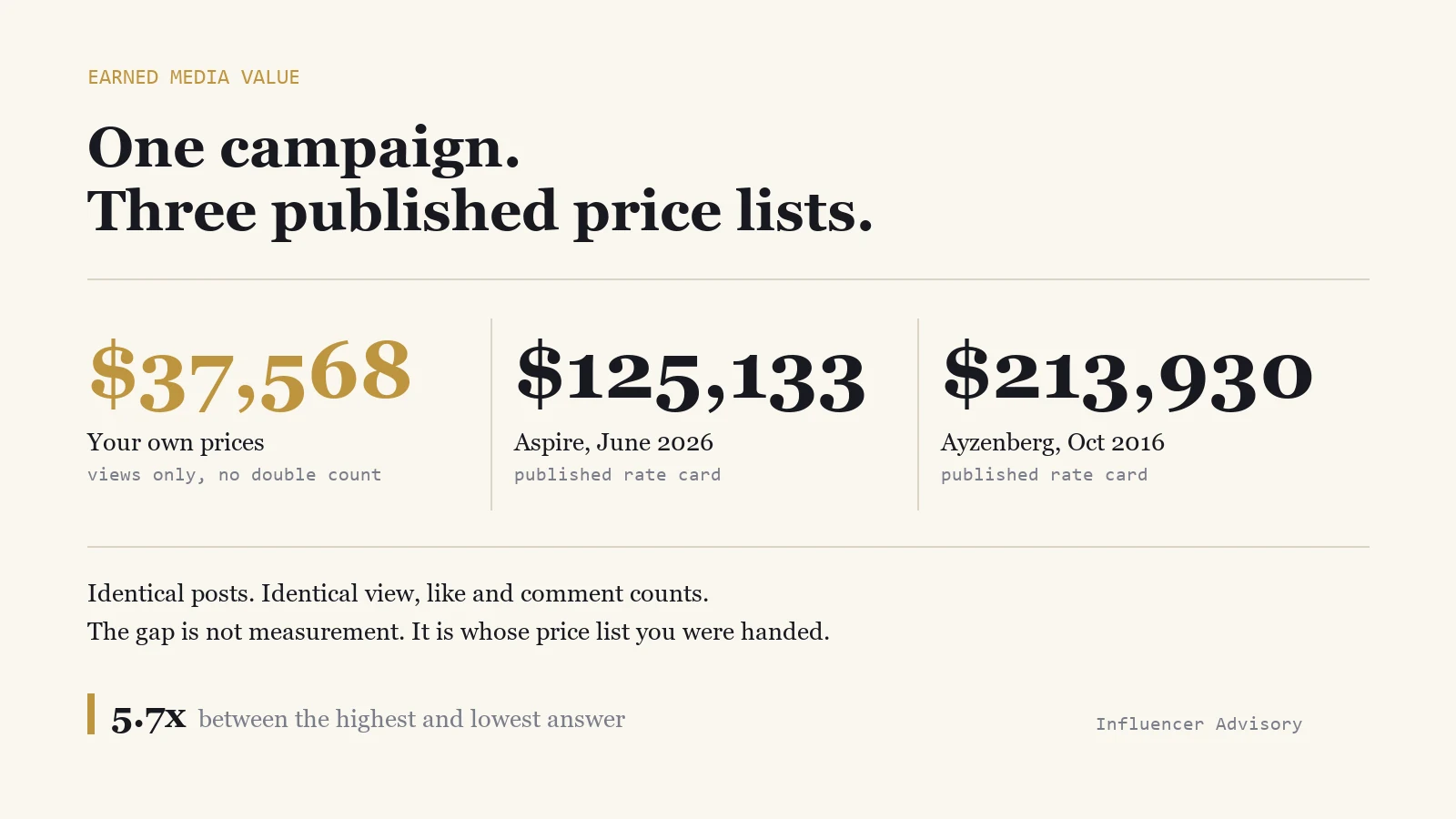
The example data that ships with it produces $37,568 on your own prices, $125,133 on Aspire's, and $213,930 on Ayzenberg's. Same three posts, same three sets of published prices, 5.7 times apart.
That spread is the deliverable. It is what tells you how much of an earned media figure was measured and how much was chosen.
There is one switch on Step 1 worth understanding. You can price an earned social post against your display advertising or against what you pay creators, and those differ by roughly six times. Creator rates are the fairer comparison for a creator post, so that is the default.
9. Where we come in
Most brands do not get burned by earned media value because the arithmetic is wrong. They get burned because a large number goes into a deck with nothing beside it, and then someone senior asks what happened to sales.
We set the measurement plan before a campaign starts, so the method is written down, the price list is named, and the outcome metrics are being collected from day one rather than reconstructed afterwards. On the compliance side, we also keep the disclosure and vetting right, because an earned media figure built on a partner who blows up is worth less than nothing, and the current FTC rules on creator disclosure carry penalties that land on the brand, not the creator.
If you want that done for your next partnership, tell us about it and we will send back a measurement plan and a creator shortlist.
For the numbers behind the price of attention, our breakdown of YouTube CPM by niche shows how far the cost of a thousand views moves between categories. If you sell in stores and cannot see a click, proving a creator campaign worked without ecommerce data covers the harder version of this problem. And before you sign anyone whose earned coverage you plan to count, what worked and what blew up in celebrity endorsements is worth twenty minutes.
Frequently asked
What is earned media value?
Earned media value assigns a monetary figure to exposure a brand receives without paying for it, such as press coverage, organic social shares and fan discussion after a celebrity partnership. It is an estimate of what that exposure would have cost as advertising, not money the brand received.
What is the difference between EMV and MIV?
Earned media value is a general term for the additive method, where you count actions and multiply each by a price. Media Impact Value, or MIV, is a proprietary algorithm owned by Launchmetrics that multiplies a base cost by source and content factors instead of adding actions together. Launchmetrics says MIV weighs more than 100 attributes, and does not publish the weights.
How do you calculate earned media value?
The common formula is impressions divided by 1,000 times a CPM, plus likes times a price per like, plus comments times a price per comment. Some tools then multiply the whole result by an earned multiplier, which is 2.89 in Klear's published example. The honest version counts impressions only at your own paid CPM, because charging separately for the view, the like and the comment bills the same person three times.
Is earned media value a credible metric?
The industry's own measurement body says no. AMEC's Barcelona Principles version 4.0, published June 2025, lists Earned Media Value by name alongside advertising value equivalency and says these are variations of the same flawed metric and should be avoided. AMEC also instructs practitioners to avoid the words value, impact and ROI when describing this class of number.
What should I use instead of earned media value?
Measure outcomes in the same weeks as the coverage. Branded search volume, direct sessions, new customers, discount codes redeemed, and the share of sentiment that was positive. If you still need an exposure figure, report it as a range across at least two methods and state the multiplier you used.