
The Whole Gut Health Drink Aisle Has 93 Sponsored Videos
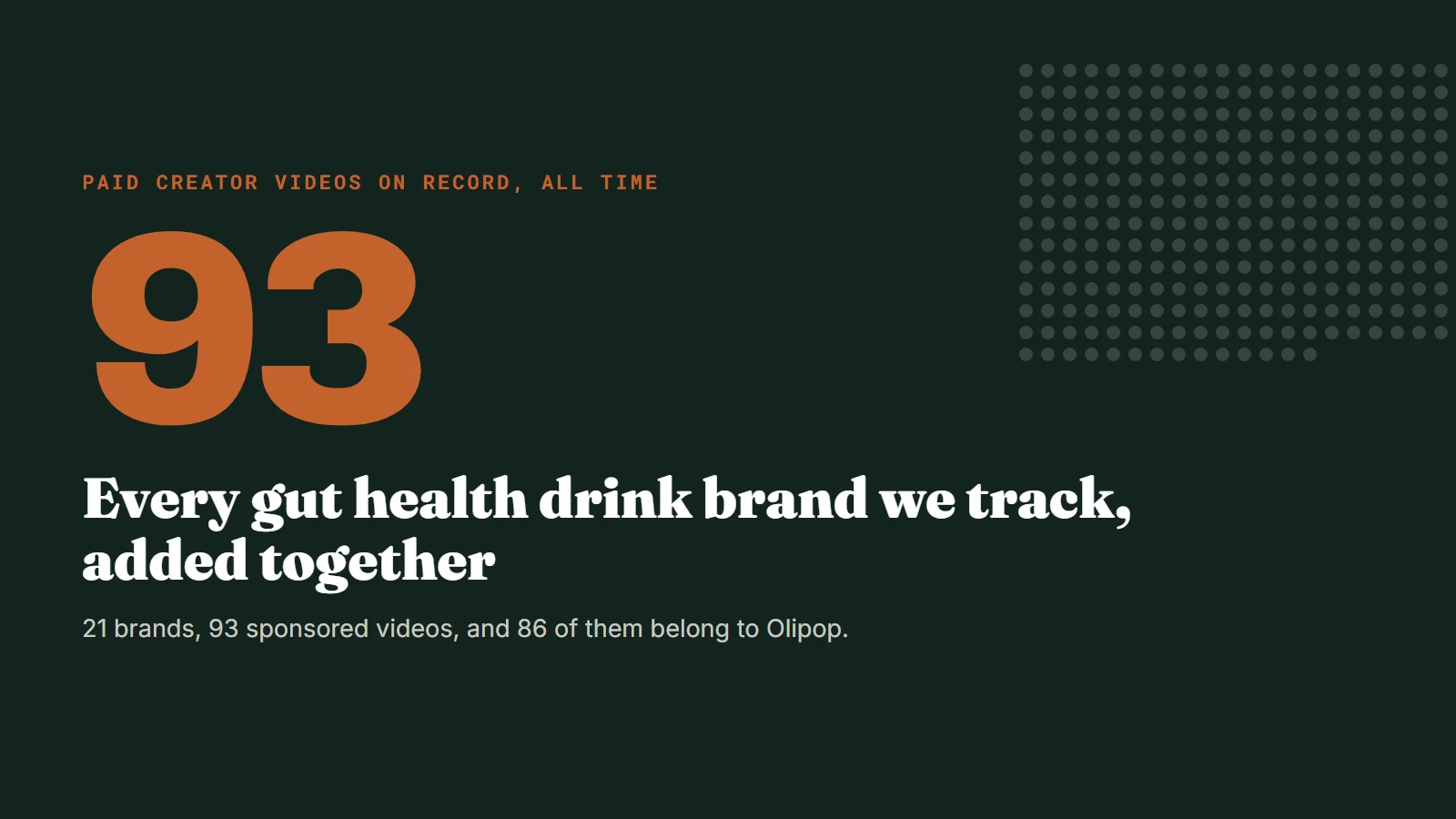
We counted every paid creator video for 21 gut health drink brands. There are 93. The same gut story sold as a capsule has 1,718, which tells you the problem is not the pitch.
Senior Partnerships Manager · 7 min read · Updated August 11, 2026
The whole aisle, added up
We hold 750,888 paid creator videos in our sponsorship database, going back to 2007.
Across 21 gut health drink brands, meaning prebiotic sodas like Olipop and poppi plus the kombucha, kefir and cultured shelf, there are 93 of them.
That is one video in every 8,073.
Every lane in that chart is a hand-picked list of real brands rather than a whole category, so it is a fair fight, eight VPN companies against 21 gut health drink companies.
The obvious objection is that the crowded lanes just hold more companies, so we counted it again per brand.
The average brand in this aisle has bought 4.4 sponsored videos in its entire life.
The same story sells fine as a pill
This is the part that changes the argument.
Take the identical promise, better digestion, less bloating, a happier gut, and sell it as a capsule or a sachet instead of a can.
Seed has 635 paid videos. ARMRA has 498. BiOptimizers has 414. Just Thrive has 140.
Five brands, 1,718 videos, which is 344 each.
So the pitch works on YouTube. Creators will read a gut health script, audiences will sit through it, and the brands buying it keep buying more of it every year.
The drinks are the ones sitting out.
The creators are already there
The other thing a brand worries about is supply, meaning whether there are enough creators who would take the deal at all.
We counted every channel in our data that has ever been paid by a food, a drink or a supplement brand.
There are 3,974 of them, and 37 have ever taken money from a gut health drink.
That leaves 3,937 creators who have already proven they will run a food or drink read, and have never once done it for this shelf.
Nobody has to be sold on the format here, only on the brand.
There is nobody to displace
Three numbers from the 93, and the last one is the one worth sitting with.
Fifteen of the 21 brands have never bought a single paid video we can see.
Olipop owns 86 of the 93, and in 2026 it owns all 45 of them, so every measurable gut health drink sponsorship bought this year came from one company.
And not one creator in our data has worked with two gut health drink brands.
There is no relationship to break, no exclusivity to buy out, and no awkward conversation about the brand somebody read for last quarter. Every creator on this shelf is a first date.
Olipop is the only one moving, going from 5 videos in 2021 to 45 in the first half of 2026, and it does it by buying repeat podcast reads, with 52 of its 86 videos landing on just 10 shows. The Just Trish podcast alone has run 17 of them.
That is a media buy with a code on it, run at rising weight, which is why we can see it at all. The LMNT campaign breakdown shows the same shape in electrolytes, and it is the closest thing this aisle has to a worked template.
What the empty lane does not mean
Here is where an honest version of this post has to slow down.
Our source reads YouTube video descriptions, so it sees a deal when a creator posts a link and a promo code.
Health-Ade had 37 sponsored creators listed on Modash as of May 2026, and it ran a Lindsay Lohan campaign in March. GT's ran a TikTok hashtag challenge with 13 named creators. All of that reads as a zero in our numbers.
So these brands are not sitting on their hands. They are buying gifting posts and flat fee placements on Instagram and TikTok, mostly without a code, and we hold no TikTok sponsorship data at all.
What is empty is the measurable lane, and that distinction is worth more than the headline. A brand spending on tagged Instagram posts has reach it cannot price, cannot compare against last quarter, and cannot defend in a budget meeting. A brand buying podcast reads with a code knows what a partner returned within a week.
This is the part we get called about most often, because a founder can feel the spend leaving and cannot show anyone what came back. Sorting out what to measure before the first placement goes out is cheaper than reconstructing it after, and it is most of what we set up in the first month of any program.
What a first mover would actually do
The playbook is already sitting in the data, run by the one brand in the aisle that buys.
Pick shows rather than posts, because Olipop's 52 videos on 10 shows is a repeat buy and repetition is what makes a read stick.
Attach a code to every placement, so the next buy is a decision instead of a guess.
Start with creators who have already run a food or drink read, since 3,937 of them have done it for somebody else and none have done it for you.
Then watch the claims, because this is a category where the wording is now litigated. poppi paid 8.9 million dollars to settle a false advertising case over the phrase "for a healthy gut", with final approval in April 2026 and over 2 million claims filed without proof of purchase. A creator ad libbing a health claim on your behalf is the most expensive sentence in your whole campaign, and the rules that govern it are in our FTC playbook for 2026.
Who says so: the poppi settlement figure and dates come from public court filings and the reporting around them, not from our data.
For how we screen the creators themselves in this category, the functional beverage vetting playbook walks through the four archetypes and the questions we ask on the call.
The window is open, and it will not stay open
Categories do not stay cheap.
Greens powders had 26 paid videos in 2021 and 2,016 in 2025, and the price of a read went with it. Gut health supplements are on the same climb, sitting at 627 last year against 22 in 2021.
The drinks aisle is where greens were in 2021, one active buyer and everybody else watching, except this time the shelf already has around 777 million dollars of prebiotic soda sales behind it, on trade estimates, plus a 1.95 billion dollar PepsiCo acquisition of poppi.
We find, vet and negotiate these placements for brands, we set the tracking up so the second buy is based on what the first one did, and we keep the health claims inside what the science actually supports. If you sell something in this aisle and want to know which shows are open and what they charge today, that is the conversation to have.