 Influencer Advisory™
How does Influencer Advisory scale an existing influencer program?
Everything about how we work in one post: why influencer stays a side channel, the four steps that fix it, what each one costs, the results and the people.
Founder · November 10, 2026 · 31 min read
We help brands scale their existing influencer programs 3-10x in under 18 months.
We create long-term influencers by building relationships and a community.
We built the agency the way we wished someone had built it for us. We are a data company first, and our premium buys you the vetting logic, the market rates and sales per creator every week, not a summary at the end of the quarter.
Why do most influencer programs stay a side channel?
Out of every 100 marketing dollars a brand spends, only about 3 go to influencer.
That's the smallest share, for the channel that brings the best conversions, the best leads and brand value that lasts.
Upon looking further, we found that for most companies, influencer was a really small channel. It was a nice to have. It brought in a few percent extra in revenue. But if turned off tomorrow, it would make no tangible difference in the company.
Then we started looking at companies which have grown extremely quickly as enterprises, companies which have amazing brand valuations, and found that behind each of them is a strong influencer system.
Brands are paying huge flat fees per sponsored video, $30,000 for one sponsored video, and that is not sustainable from a brand or performance marketing perspective.
Influencer marketing is getting diminishing returns. Ask any company: they'll spend 2% to 3% on influencer and 30-50% on Meta ads.
When you go to negotiate with talent agents, you get hit with really high CPMs and high flat fees.
The unpredictability of ROAS, where most people can't break even on their investment with influencers, makes it hard to justify spend and continue to scale.
What most influencer programs look like today
- Cold outreach to thousands of creators to find a handful who say yes.
- 80% of the creators you onboard don't perform, and you only find out after paying them.
- New creators every 3 months, once the last ones have saturated their audience.
- Relying on your top few creators, so the program stalls the day they do.
What 50+ brands told us, and why it happens
We asked 50+ health and wellness brands why they don't put more of their budget toward influencer marketing (why they can't scale it).
| What they said | Why it happens |
|---|---|
| "We keep paying more for the same results." | Every post needs a flat fee, and creators only post when they are paid. |
| "A few creators bring in almost all our sales." | They have already saturated the creators they know, the new ones are overpriced or don't perform, and every campaign feels like starting from zero. |
| "Influencer is still a side channel next to Meta." | They want it to become a main acquisition channel with a lower CAC, and it never gets big enough to matter. |
| "Every new round of creators performs worse." | Each round goes further from your customer to find someone new, so the returns shrink every time. |
| "We never stop hunting for new influencers." | Nothing brings creators to you, so every campaign starts again with cold outreach. |
| "We can't tell who will work until we've paid them." | You guess at ROI before you sign anyone, and most of the creators you onboard never earn it back. |
Why it matters. This is why influencer stays a side channel, at roughly 2.5 to 3% of the marketing budget (eMarketer).
What they run into
- CAC is getting too high.
- No way to get influencers, macro ones included, to keep posting without paying per video.
- Fear of FTC fines years later when old videos get flagged.
- Not wanting to overhire, but short on capacity around holidays and launches.
- Not knowing which influencers are less risky, based on past campaigns.
- Generic agencies that don't understand compliance or the product.
- Diminishing returns as soon as spend scales.
What do we believe about influencer marketing?
Influencer marketing is a data problem, not a creative one.
- People will always buy from people.
- People don't trust companies. They trust people. The best brands understand the difference.
- If the influencer clearly does not use the product, the endorsement typically fails.
- Focus on retention rather than acquisition.
- Influencer marketing is building relationships.
- Influencer marketing is the foundation to scaling with paid.
- Most people get it wrong by overspending on the wrong things and treating it too heavily as performance.
Our values
- Data first. Every number on our pages comes out of a system we built, not a spreadsheet someone kept by hand.
- Trust. Health and wellness products need trust, so you are connected directly with the talent throughout, and never have to take our word for anything.
- Science. People who talk about science, often regular lifestyle creators, carry the most weight, so we turn complicated products and science into creator campaigns people care about.
- Access to top talent. Our contact list runs up to the biggest shows, The Diary Of A CEO, Joe Rogan, Wizardliz and more, and we talk with their teams directly.
- Relationships. A talent manager picks up because they already know us, and we run our own podcast, so we sit on the same side of the table as the creators.
How did Influencer Advisory start?
Founded by Alice in 2020, after working in marketing and with several AI tech and Y Combinator startups, and seeing the power of distribution this decade, to find the playbook that helps companies the most.
In the influencer agency space we saw a huge amount of distrust, and health and wellness products need trust, so we started with creators.
We used to run both a talent agency and an influencer agency. The old way, we reached out to 1,000 creators, got 50 responses and got 3 influencers. As a talent agency we had a roster of 71 creators, and few of them fit any one brand.
We found that people who talk about science, often regular lifestyle creators, carry the most weight.
We took inspiration from programs like the Nutrafol communities and built one that scales an existing influencer effort through an educated community of influencers.
A lot of supplement companies are commodities and get stuck near $50M to $200M, so we saw a big opening.
To find the playbook in the weeds, we talked with the CMO of AG1, the CEO of Onnit & the CMO of Feastables.
We bet that people will always buy from people, so relationships and brand awareness come first.
What each thing we tried got wrong
| What we tried | What went wrong |
|---|---|
| YouTube coaching | We tried YouTube coaching to help influencers. But we found that we weren't able to help them make that much. |
| Commission-only affiliates | You're reaching out to a lot of influencers and asking them for commission, and you're getting ghosted by most of them, and they're not interested. |
| When we were an influencer agency | As an influencer agency, the good creators kept getting more expensive. Every year the CPMs went up, and now it's not uncommon to see $50 or $100 CPMs, especially in educational spaces. The cheap ones had views too small to move the needle. |
| When we were a talent agency | As a talent agency, you're boxed into one roster, and the question is how many of those people actually like your brand and fit the audience you're trying to reach. And the agency is negotiating against you, because it represents the talent. |
| Paid media | We did some paid media, but then we realized that was ineffective. We've run plenty of campaigns ourselves at breakeven ROAS. |
| One-off campaigns | We used to do a lot of one-off campaigns, but we stopped, because with this new system we found that performance increased, and that's what allowed us to scale influencer. |
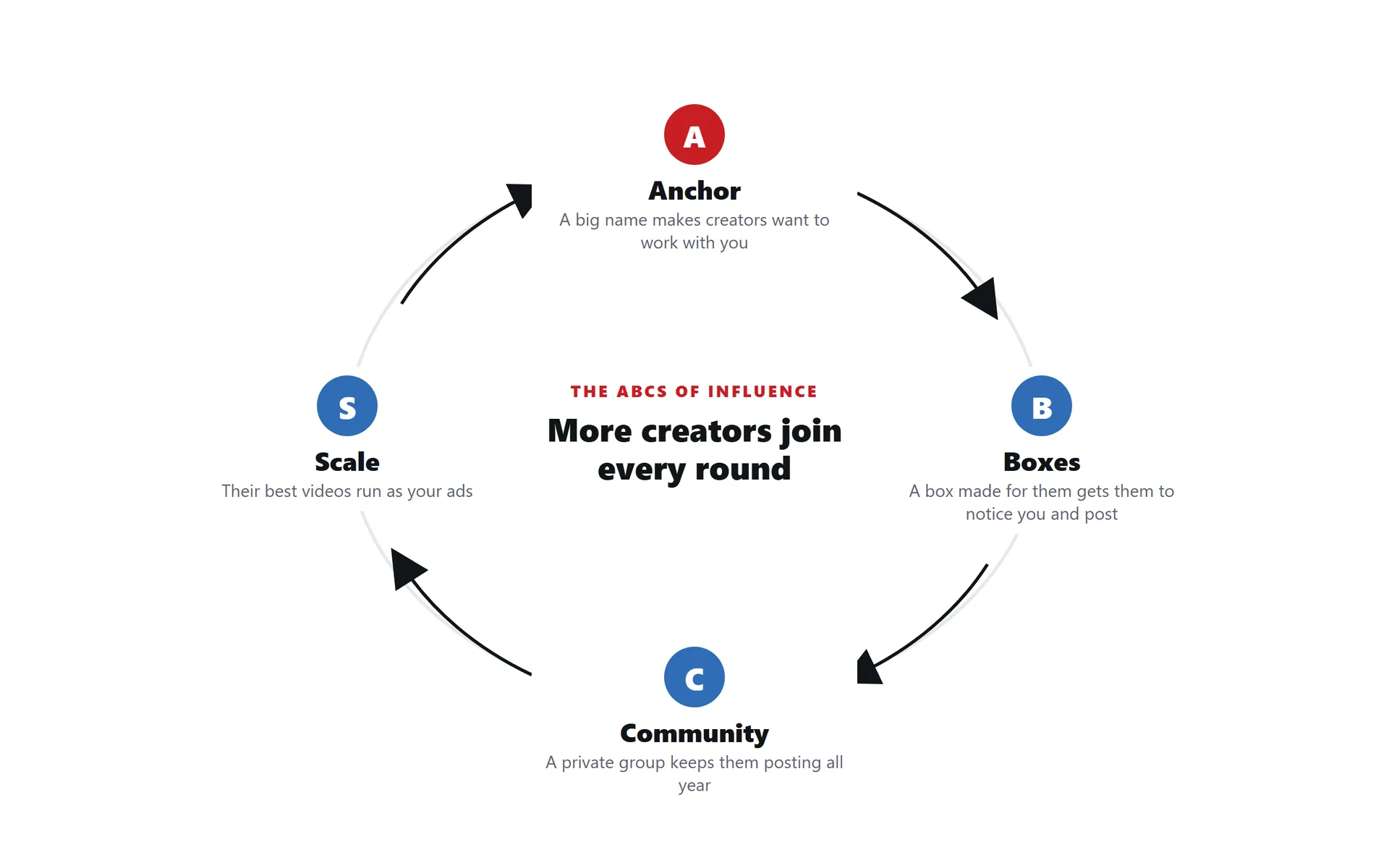
So we switched. So we built a new model: short-term media buying and long-term influencer affiliates. We find the creators who already like your brand, keep them in a community, and run their best videos as ads. That's the ABCs of Influence.
Milestones
- Oct 2020. Alice starts Influencer Advisory as Managing Partner.
- 2022. Alice launches Vie Lariat, a jewelry brand, and it fails.
- 2023. Alice launches Unthinkable, a sweatwear brand, and it fails too.
- 2024 and 2025. Alice helps scale FixonAI, then WillowAI (Y Combinator), and grows the agency alongside.
- Mar 2026. TacPack videos go live on 13 Mar, and the Nami Matcha gifting round goes out from 25 Mar.
- Jun 2026. Rumble Wallet's 6 videos run 24 Jun to 4 Jul, and the Brand Growth Podcast starts (first named the Wellness Partnerships Podcast).
Where we are now
- 55+ brands in the last year.
- Helped companies 2 to 3x their Black Friday launches.
- Generated significant earned media value, and worked on campaigns that helped raise brand valuation at a sale.
- Expanding quickly across North America.
What is the ABCs of Influence?
We built a system called the ABCs of Influence. Each step is one of the most effective marketing moves on its own. Together, they make an influencer flywheel: every round brings in more creators than the last.
- A, Anchor. One celebrity in your space makes other creators want to work with you, often for less. We headhunt the right one, which can be a multi-million investment. Proof. Bum Energy was quoted $10,000 by creators, and weeks later the same creators offered $2,500.
- B, Boxes. Personalized PR boxes built for one creator, so the unboxing is worth filming, ideally with gifts tied to something they said in a video years ago. Proof. SugarBearHair had influencers jealous of each other's boxes.
- C, Community. A private creator community with perks, so creators like your brand before any offer and keep posting all year without a flat fee each time. Proof. NeuroGum's 500-influencer group got million-subscriber creators to post without a contract.
- S, Scale. Whitelisting. We test the creator content as paid ads and put budget behind the winners, so the creator program is the testing ground and paid media is the amplifier. Proof. HexClad's head of growth puts 90% of the influencer budget into whitelisted content and 10% into the creator fee.
Why the four steps work together
- Anchor. A big name makes creators want to work with you. When creators see someone they look up to working with you, they want in, and they ask for less.
- Boxes. A box made for them gets them to notice you and post. Creators get 50-plus packages a week, and most are just product. A box made for them is the one they notice and post.
- Community. A private group keeps them posting all year, and new creators ask to join. They keep posting all year for the perks, instead of charging you a flat fee for every post.
- Scale. Their best videos run as your ads. You now have far more creator videos. We test them as paid ads and put the budget behind the winners.
More creators join every round, so the next round starts bigger. That's the flywheel.
The playbook the most successful brands used
Each brand below made influencer one of its biggest, most profitable ways to get customers. Here is the part of the system that did it.
| Brand | What it did |
|---|---|
| NeuroGum, through a creator community | Went on to become a $1B company, with influencer as its main channel. Put 500 creators in a private Discord with perks. The creators kept posting, without a fee for every post. |
| SugarBearHair, through PR boxes | Got creators fighting to get into its program. Sent creators the best PR box in the category. Creators outside the program asked to be let in. |
| Bum Energy, through a celebrity endorsement | Got creator quotes down 75%. Signed Chris Bumstead first. Creators who had quoted $10,000+ a month came back at $2,500. |
| HexClad, through whitelisting | Turned creator ads into a $400M brand. Ran creator videos as ads. 90% of the influencer budget goes to the ads, 10% to the creators. |
What you get from each step
- Anchor. Creators ask to work with you, instead of you chasing them. Lower quotes from the creators who follow the big name in. Buyers trust your brand more from the day the name goes up. Credibility that takes other brands years to build. More interest from retailers. Press you would otherwise pay for.
- Boxes. You stand out in the 50-plus packages a creator gets every week. Creators post about you because they want to, not because they were paid to. Posts for the price of a box, instead of a creator's full fee. Reply rates up 100% to 500%. A shortlist of creators who already like you, ready for step C.
- Community. Creators keep posting all year, without a flat fee every time. New creators ask to get in, so cold outreach shrinks. Creators share hooks and ideas, so the content gets better. Videos you can run as ads. Small creators tell you what to fix in your product.
- Scale. Far more creator content to test as paid ads. Budget goes to the proven winners, and the rest are cut fast. Influencer grows into a channel big enough to sit next to Meta. A new audience almost right away, from the creator's handle. New-customer costs 20% to 30% lower when the creator gets a cut of the spend. Every creator deal can become an ad, because the rights are already signed.
- Affiliate & TikTok Shop. Hundreds of creators posting about your product every month. Sales on TikTok Shop, paid on commission. A steady supply of videos you can run as Meta ads. Sales lift on Amazon and your own site, not just the shop. A clear read on which products sell on TikTok.
The five moves inside each step
| Step | The five moves |
|---|---|
| Anchor | Decide if a celebrity is worth it, and when. Find the name your buyers already follow. Check them before anyone signs. Pick the deal shape, then write the work in numbers. Use the name on every creator after it. |
| Boxes | Pick who gets a box. Find what each creator cares about. Build a box worth filming. Send it with no ask attached. Follow up with the ones who post. |
| Community | Set who gets in and what they owe. Put a reward ladder on top, and keep the top rare. Give perks money can't buy. Run the room so it stays alive. Turn it into posts and ad rights. |
| Scale | Write the ad rights into every deal. Ask for a permission, not a password. Cut several ads from each video. Give each idea a fair test. Scale the winners, then bring in new creators. |
| Affiliate & TikTok Shop | Pick the products that sell on TikTok, not your bestseller. Build the shop before you scale it. Pay creators in 3 layers. Move the winning videos into your Meta ads. Tell creators what sells, and count every channel. |
Each step has its own long guide in the ABCs of Influence.
Where does each step go wrong?
Anchor
- Anchor. Fewer than 12% of celebrity ads beat a 10% lift, and 127 celebrity brands shut down in 2024.
- Anchor, right name, wrong audience. Ridge sponsored her YouTube series and ended up in front of 17-year-old girls, not its own buyer. The mistake was where the ad sat: inside a show watched by teen girls.
- Anchor, new visitors who were not new. Rogan had mentioned his Ridge wallet, and Ridge paid to use the clip. The ad showed very high new visits and strong sales, but mostly reached people who had already seen Ridge ads.
- Anchor, the first choice cost too much to close. Vita Coco wanted Jay-Z as its face. The deal kept getting pricier and harder, so it went with Rihanna.
- Anchor, one name is never the whole bet. Ketone-IQ spreads its bets across many partners and tests before it signs a star.
Boxes
- Boxes. Most gifted posts can't run as ads. Ridge gets maybe 2 good ones from 100 wallets. The biggest names are already signed by bigger sponsors.
Community
- Community. Brands send 5,000 sample requests to random creators in a day and never build a relationship. What fixed it: NeuroGum treats creators like its own team, and talks with them every single day in its own channel.
- Community. Sending product to 4,000 people in a month says nothing about who keeps posting after. What fixed it: ColourPop gave creators masterclasses with Patrick Ta, access they could not buy. They posted about the brand and the day.
- Community. Sending boxes alone does not keep creators posting. What fixed it: Jones Road follows up when someone posts, keeps sending product, and gives big creators a free in-store appointment. Almost everyone who gets one posts.
- Community. Community takes staff, events and logistics. Its founder says a phone case brand should skip it. What fixed it: Halfdays fits it to a sport people already love. Ambassadors run the local events, and a community manager helps plan them.
Scale
- Scale. A lifestyle creator signed for 9 months. After a month, her 1-day click ROAS fell below HexClad's normal bar. What fixed it: HexClad kept spending. Her ads brought strong engagement, lots of new visitors and a different age group, who may need longer to buy.
- Scale. Ridge once made new ads beat its old ones by 20% before it would fund them. What fixed it: A new creator is worth it at the same cost per buyer, because it adds buyers the old ads can't reach.
- Scale. A premium honey brand scaled well with biohacker creators, then asked which new ad channel to try. What fixed it: The bigger gap was people. Parents and morning coffee drinkers buy honey too, and it had no creators speaking to them.
- Scale. Jones Road ran 6 to 8 look-alike cuts per idea in one ad set. Meta treats them as too similar and finds one winner at best. What fixed it: It cut to 3 or 4 cuts per idea, and puts the effort into more different ideas.
Affiliate and TikTok Shop
- Affiliate & TikTok Shop. Its May contest paid for video volume. Too many creators posted wallet videos that did not sell and rarely became GMV Max winners. What fixed it: Better briefs, better product direction, and rewards that balance quality with quantity.
- Affiliate & TikTok Shop. Its TikTok Shop P&L looked terrible once seeding, commission, contests, retainers and GMV Max were counted. What fixed it: Count the videos reused as Meta ads and the sales on other channels. A lift test found 88% of GMV Max lift outside TikTok.
How does a celebrity deal work with us?
Why it matters. The talent's agent on the other side is paid to get the highest price. We work for you, compare the market, and make sure you never bid against yourself.
- We meet your team to understand the creative and the positioning.
- We map talent against your goals, your timing and any exclusivity you need.
- You bring rough price ranges, then decide who you want.
- We run the talks directly, with payments moving through protected channels.
- Only once both sides commit do we move to legal drafting and production.
- Through the campaign we measure, adjust and coordinate.
- When it wraps we analyze it and decide whether to continue, double down or source new talent.
The celebrity partnership
| Stage | What happens |
|---|---|
| Map | We source the full celebrity landscape and find who fits your audience. |
| Analyze | Past campaign performance, audience overlap and reputation risk on every candidate. |
| Shortlist | A vetted list to choose from. |
| Introduce | A meet and greet dinner in LA or NYC with your finalists. |
| Negotiate | A 10 to 30% discount on rates, for a 9% commission. On most deals the savings cover our fee. |
| Commit | You sign a $250K to $5M partnership knowing it's the right one. We've seen these return 5 to 20x. |
What you get first on a celebrity search
- 10 to 20 qualified celebrity targets, picked for brand fit.
- Audience analysis, past endorsements, and a reputation and controversy screen on every name.
- The current representation and the decision-maker behind each target.
- An estimated fee range, likelihood of interest, and expected reach and CPM.
- A recommended deal structure and the 3 names we would approach now.
When the celebrity search fits
- Your talent budget is $250,000 or more.
- The decision-maker is in the room from day one.
- Your launch or turnaround lands in the next 3 to 12 months.
- It does not fit if you need something live inside two weeks.
Who the Anchor step fits, and who it doesn't
- Fits. Brands that make and sell their own product.
- Fits. A launch that needs trust faster than it can be earned, or a product already on shelf that is not moving.
- Fits. Companies where one endorsement is a material amount of money, so getting the name wrong is a board-level problem.
- Fits. Teams that want the talent relationship handled end to end, not a list of names emailed over and left with them.
- Does not fit. Retailers, pharmacies and marketplaces. You stock other people's products, so there is no brand here to endorse.
- Does not fit. Anyone who wants a single post from a big name at the lowest possible rate. That is a booking, and you do not need us for it.
- Does not fit. Teams with no budget for talent yet.
What we will not do
- No guaranteed sales number. Brands that want a guaranteed sales number attached to a celebrity do not fit. Nobody can honestly promise that, and we will not.
- The vetting is never skipped. It fits. Founders who would rather hear that a candidate has a problem in their history than find out after signing. It does not fit. Anyone who wants the vetting skipped to move faster.
- A big name speeds up something that sells. Your funnel already turns visitors into buyers, so a big name speeds up something that sells. Fame creates a trial window. Only the value that comes after it makes a loyal buyer.
That a celebrity will fix your sales. Nobody credible can promise that.
How does working with us run?
We're not replacing your team. We only work with brands that already have an influencer team. We put the system in, run it next to your people, and teach it to them.
- We learn your goal and your brand. Before any money changes hands, we sit down with your creative team to learn your product, your story and your goal, whether that is a launch, a new market, a new audience or a lower CAC.
- We audit your program. We look at how far you already go on each of the four steps and find the gaps.
- We test the big bets first. For big plays like a celebrity signing, we test with Sapiens, our consumer insights provider, before you commit.
- We install the relationships and systems. We work alongside your creative and paid teams, and handle the logistics, fulfillment, negotiations, contracts and creator management.
- We hand it off to your team. We train your team on every system and join your quarterly meetings to report on the KPIs, adjusting as we go until your team runs it without us.
Our principles
- We advise the brand. Talent agencies represent the talent. Their responsibility is to secure the strongest possible terms for their client. We advise the brand, independently, across the full market.
- One brand per subcategory. Will you work with our competitors? No. We represent one brand per subcategory.
- A relationship, not a transaction. Money motivates creators only so far. A community compounds. A creator who becomes a fan talks about you for years. That is worth more than one paid post.
- Send it with no ask attached. Say it comes at no cost, and they don't have to post about it.
- Measure it in weeks, not days. If every dollar must be attributed to an immediate click, the model will not suit your organization.
- You keep the creative. We understand that you know your brand best, and that's why we collaborate closely with your creative team.
A creator's paid post vs their video run as your ad
- Paid posts. You pay a creator for one post.
- Creator videos run as your ads. Creators post all year, and you pay to show the best videos as ads.
- Higher with creator videos run as your ads. Customer lifetime value. Landing-page conversion. Repeat-purchase rate. Conversions when you retarget. Enterprise multiple.
- Lower with creator videos run as your ads. Cost to acquire a customer.
How the planning runs
- Map your existing creative strategy, and run an influencer analysis of your competitors and brands in adjacent spaces.
- Develop the creative angle off your own selling points, with our in-house creative specialist, looping in influencers and celebrities.
- Build the influencer plan of who to source.
Creator dinners
- Hundreds of UGC pieces for your paid media and website.
- Creators in Toronto with 10,000 to 150,000+ followers post your PR box too.
- Relationships with dozens of health & wellness creators, plus honest in-person feedback on your product.
- We handle everything, from vetting, invitations and venue to menu, concept and production.
- Launching something? We build the whole night around it.
The free audit
If you have some of the steps in place, we audit what's missing in each and how to take it further.
For qualified brands planning their next quarter. They apply and tell us the one thing they want their program to do next.
Who is this for, and who is it not for?
You already have an influencer program and a team running it.
It fits when
- You sell a subscription, consumable or renewable product.
- You want PR, earned media value and a household brand.
- Your KPIs are brand valuation, a 365-day payback period and customer lifetime value.
- You want better Meta ads from influencer-made whitelisted content.
It does not fit when
- You only sell one-time purchase products.
- You use ROAS as your main KPI, or you only want performance marketing.
- This is your first influencer campaign.
- You run no paid amplification, or haven't found Meta ad formats that work yet.
When brands hire us
- Shelf velocity after a major retailer. After getting into Sephora, brands need strong sales in the first 90 days or risk not being taken back.
- A new segment after a repositioning. Athletic Greens became AG1 and went from athletes to everyday people.
- The right celebrity for a big investment. Nike & Michael Jordan made billions, while Adidas & Yeezy lost billions after poor vetting.
- A new region. Celsius used local U.K. influencers to speed up growth after the U.S.
- An influencer community. Nutrafol's science-backed influencers, NeuroGum's groups on Discord.
- City by city. Local influencer events, creator dinners, partnerships with clubs and groups, PR stunts.
- Lower rates through relationships. Creator dinners build goodwill and can cut rates 5-10x for the cost of one dinner, instead of paying $100+ CPMs.
What brands hire us to do
- Make influencer your main acquisition channel, with the lowest CAC.
- Get creators coming to you, and asking for less money.
- Keep creators posting all year, without a flat fee every time.
- Stop paying $100+ CPMs, by building real relationships with creators.
- Put ad money behind the creator content that already works.
Which step leads for each goal
| Where you are | What leads |
|---|---|
| You just landed a major retailer | Boxes and Scale lead. Seed hard around the launch window, then whitelist the best content to the areas where you are on shelf. |
| A repositioning or a new audience | Anchor leads. |
| You are about to sign a celebrity | Anchor leads, tested first. We test with Sapiens before anyone signs. |
| Expanding into Europe or Asia | All four, rebuilt locally. A local anchor, local creators and a local community. |
What brands want from an agency
- They don't want to hire a stack of people just for the holidays or a launch and let them go after.
- They don't want contractors they have to teach their system and flows to.
- They want an agency that has done it before, knows creative, and holds data from past campaigns on what works.
- They want to keep creative control, stay compliant with the FTC, not eat their team's time, and have a system instead of trial and error.
- They want to reach more levels of the funnel.
What makes us different from other agencies?
We are the intermediary between you and the talent. Most agencies in that seat charge a markup for nothing. We get you a discount, which on a multi-million dollar partnership is the whole conversation.
We turn whitelisting into a system you can run at scale.
We go city by city, so you own one market before moving to the next.
We turn complicated products and science into creator campaigns, often with creators who already talk about health, science, fitness and wellness every day.
From mapping and headhunting through to negotiation and creative development, we manage the whole partnership, and protect the brand from an expensive mismatch.
Top-tier talent. We have relationships with celebrity teams at CAA and WME, built from constant time in LA, New York, Toronto and at industry events, which gets negotiated rates & exclusive partnerships.
200+ talent agencies. Part of our team is in LA, and we are at the events where these deals get made, so we buy in bulk and negotiate down.
Data. For any launch there are maybe 1,000 people who technically fit, 100 who could work, 10 who are good and 3 who are right. We've streamlined the research that finds the three.
- Expansions & launches. New regions, new products, holiday capacity, repositioning, new customer segments.
Most agencies hide the landscape from you, only take enterprises that already have an internal influencer team, and only know how to sell wellness and supplements. We do the opposite.
We build the program around what you sell, including regulated categories and B2B, and when it needs to be bespoke we find the celebrity name that changes how your market sees you, which is why we spend so much time in Los Angeles.
Why trust us
We are not a fifty year old agency, and we don't pretend to be.
We've done this for five years, which is why we let the data speak instead of leaning on a logo.
You are connected directly with the talent throughout, so you never have to take our word for anything.
What we own
- Databases with 160,000+ YouTubers and millions of datapoints.
- A system tracking 688 companies and 1,568 creators, with rates, grades, average views, engagement and every conversation in one place.
- It scans sponsored videos to find who a brand has already worked with, and grades a creator before we suggest them.
- So we can tell a brand what a creator charges, and answer "has this creator worked with our competitor" in a minute, not a week.
What results have we had?
| Client | What happened |
|---|---|
| Rumble Wallet | 6 videos, 24 Jun to 4 Jul 2026, 2 creators, 954,558 views, 1,931,000 subscribers reached. The hosts, 2 of the 47 finance creators we hold, were under a $30 CPM, and one read was refilmed after we caught an FTC risk. Rumble kept Jon Law on for six months and counting. |
| TacPack | 5 creators, 13 Mar to 31 May 2026. First counted at 15 videos, 513,856+ views and $20,000 in sales off one video. Measured again on 28 Aug at 831,950 views across 11+ videos, and 25 of 35 tracked sales came from one creator, Vietac. |
| Nami Matcha | Gifting round, 25 Mar to 14 Apr 2026. 984 emails, 68 replies, 26 creators took the product, 20 named on the agreement, 4 asked to be long-term ambassadors. |
| Typhur | 3,573,258 impressions across the campaign. |
| FOREO | 3 units sent, 3 creators posted, close to 200,000 impressions, $0 in creator fees. |
| Green Revolution | A licensed Washington cannabis producer. A 3 month pilot with 5 to 10 creators at $8,000 a month. 5 Instagram messages brought in $6,150 of the $7,200 committed, more than 367 cold emails did. |
| Shippo | Approved 3 Jul 2026, not live yet, and 38 creators we emailed wrote back. |
| doola | 1 video on 18 Feb 2026, 7,364 views, 57,700 subscribers reached, code RITESH10. The creator came up with the idea and title. |
What clients said
"If you do not deliver what you are saying you will, you also take the risk with us in terms of getting back into it. They are really willing to make the number happen." Alexandre V., Partner Marketing Manager, Shippo
"This is kind of exactly what I was looking for. I like that it seems nice and simple. I have talked to some agencies before where it just feels like it gets really convoluted." Daniel G., Marketing Manager, TacPack
Who is on the team?
Dennis sold sponsorships for creators before he bought them for brands, so he knows where the padding hides in a rate, and he built the database of 700,000+ sponsorships we price every deal against.
Alice launched two brands of her own and lost both, so she knows what it feels like to spend your own money on an ad that goes nowhere.
Our own podcast, other people's stages, brand activations and the studio: the same two people, Dennis and Alice, are in all of it.
Alice Ksendzova, CEO
- Alice runs Influencer Advisory.
- She helped scale teams at GetCove, Fireflies.ai, Fixon AI (a Stan Store competitor) and Willow (Y Combinator), plus other creator startups.
- She saw that partnerships were only a small slice of that work, so she chose to help brands directly.
- She now builds the overall strategy, making sure the segment you want matches the creative and the creators.
- She is an expert in acquiring customers at a low cost, then raising lifetime value through offers, promotions and automations.
"I look at comment quality first. If I see mostly AI slop, that usually means it's bought, so I avoid those creators."
Dennis Ksendzov, Senior Partnerships Manager
"Brands were paying $30,000 for one sponsored video that did not hit a single KPI."
- The numbers guy. Dennis knows what is typical for an industry, what is overpriced, what is underpriced, and where the arbitrage is.
- He helped build the agency to 50+ brands, most of which buy again.
- He built our database and tools, and worked out how to measure influencer attribution over long horizons, including its effect on valuation, earned media from stunts, and creator dinners.
- Before that, at YouTube Advisor, he helped YouTube creators build products and monetize. As a creative director, he worked on thumbnails, hooks and creative for fitness and health YouTubers like Football Fundamental and Ground Glory, so he knows what makes an outstanding ad.
- His path: Civil Engineer, Machine Learning Developer, AI-leveraged marketing systems, then data & human focused influencer marketer.
The rest of the team
- Billy Anderson. Performance Analyst.
- Falicia Lafa. Creator Research, leads creator sourcing.
- Consultants. Specialists in supplements, health & wearables, and beauty.
What does it cost?
It's hard to give numbers before the audit. Brands that want to start with one part can start with the audit.
These are the prices we publish, the same as on our agency cost guide, as of October 2026.
- Free audit. For a brand that already runs an influencer program, we look at what it has and where the money goes.
- Boxes, $9,000 a month. We seed product to 100 creators and about 30 of them post, with no flat fee a post. Product, shipping and software are passed on at cost.
- Community, $9,000 a month plus $15,000 once to set up. A private place that keeps the creators you already have, with a $50,000 minimum community budget passed on at cost.
- Scale, 24% of ad spend. For a brand on TikTok Shop that also sells on Amazon or in retail and already spends on paid social, with a minimum of $90,000 a month in spend.
- The whole system, $40,000 a month plus $40,000 setup. All three plans together for the first 90 days, plus 24% of the ad spend behind creator videos.
- Anchor, 9 percent commission. A celebrity add-on, charged on the partnership, and we negotiate 10 to 30 percent off rates.
- TikTok Shop community, $17,000 a month for 3 months. 600 posts guaranteed, and $85 back for every post short. How it compares is in how TikTok Shop agencies charge.
How we frame it. To get a new acquisition channel bringing in tens and hundreds of millions, you invest in celebrity partnerships, mass personalized PR boxes, a community of loyal influencers, and paid ads with influencer content.
On celebrity deals we take 9%, which covers the data work, managing the talent, and coordinating your creative team with theirs.
"What does a celebrity deal cost?" To get a celebrity to post for 3 to 5 months, plan on high six to high seven figures.
What do brands ask us before they sign?
We already have an influencer team and a paid team.
Great, that's the only kind of client we work with. We find the bottlenecks in your creative, your systems and your creator relationships.
Can we just do one step, like the community?
All the steps together make the numbers work. After the audit we'll know what fits.
What KPIs measure success?
It depends on the goal: brand valuation, cash flow or otherwise. We set it in the audit.
We want to control the creative.
You keep creative direction. We work alongside your team.
How are you different from other agencies?
We're not a traditional talent or influencer agency. We install the systems and teach them, so in 6 to 18 months you run it in house.
What about health claims and the FTC?
Every brief carries only claims you can back up, and we review content before it posts and before it runs as an ad. That's how we caught a risky line on a Rumble video and had it refilmed.
Why does the system take months?
You've started to build connections with influencers that really like you, and of course this is something that's done over a few months. That's why an entire system takes 6 to 18 months on average.
Why not approach CAA or WME directly?
Talent agencies represent the talent. Their responsibility is to secure the strongest possible terms for their client. We advise the brand, independently, across the full market.
How do you work with our existing agency?
Alongside them. We lead the search, risk assessment, talent negotiation and creative development. Your agency can then execute the campaign across media, production and distribution.
Will you work with our competitors?
No. We represent one brand per subcategory.
What if the celebrity already uses our product?
That is the best place to start.
What happens if the talent creates a reputational issue during the campaign?
That possibility is addressed before launch. The agreement defines the brand's rights, and the response plan is written before it is needed, not after the first headline appears.
Where do we come in?
We send you elsewhere when we are not the fit. If we are not the fit for you yet and you still like where this is going, message us and we'll refer you to another agency or tool.
If you already run a creator or affiliate program and want it to grow into a main channel, apply for the free audit and we will show you which of the four steps you already have and where the gaps are.
- One level up, the ABCs of Influence in full.
- On the same subject, what an influencer agency costs.
- Before any creator posts for you, the FTC disclosure playbook for 2026.
Frequently asked
We already have an influencer team and a paid team.
Great, that's the only kind of client we work with. We find the bottlenecks in your creative, your systems and your creator relationships.
Can we just do one step, like the community?
All the steps together make the numbers work. After the audit we'll know what fits.
What KPIs measure success?
It depends on the goal: brand valuation, cash flow or otherwise. We set it in the audit.
We want to control the creative.
You keep creative direction. We work alongside your team.
How are you different from other agencies?
We're not a traditional talent or influencer agency. We install the systems and teach them, so in 6 to 18 months you run it in house.
What about health claims and the FTC?
Every brief carries only claims you can back up, and we review content before it posts and before it runs as an ad. That's how we caught a risky line on a Rumble video and had it refilmed.
Why does the system take months?
You've started to build connections with influencers that really like you, and of course this is something that's done over a few months. That's why an entire system takes 6 to 18 months on average.
Why not approach CAA or WME directly?
Talent agencies represent the talent. Their responsibility is to secure the strongest possible terms for their client. We advise the brand, independently, across the full market.
How do you work with our existing agency?
Alongside them. We lead the search, risk assessment, talent negotiation and creative development. Your agency can then execute the campaign across media, production and distribution.
Will you work with our competitors?
No. We represent one brand per subcategory.
What if the celebrity already uses our product?
That is the best place to start.
What happens if the talent creates a reputational issue during the campaign?
That possibility is addressed before launch. The agreement defines the brand's rights, and the response plan is written before it is needed, not after the first headline appears.